Q: About Sarracenia alabamensis, the cane-brake and Wherry's pitcher plants
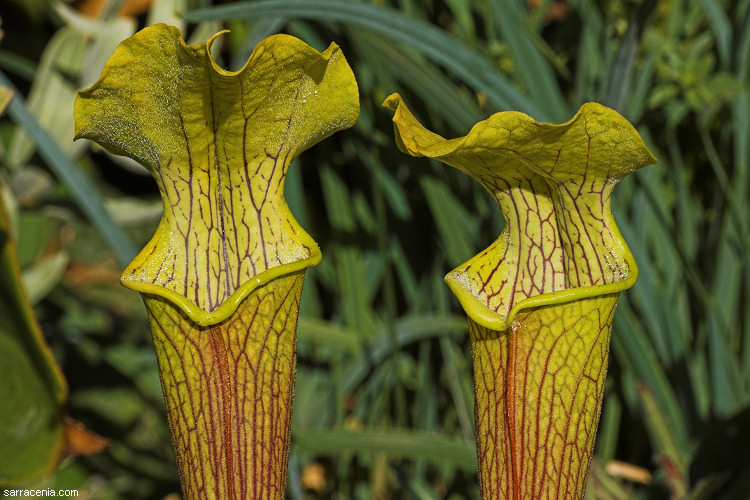
S. alabamensis
subsp. alabamensis
A: This is one of the species that are embroiled in some controversy. There are two ways of classifying this plant.
The first is to consider it a subpecies of Sarracenia rubra, and the other way is to consider it a full
species. In summary:
- Method #1--as per McPherson & Schnell (2011)
- Sarracenia rubra Walt.
- S. rubra subsp. alabamensis (Case & R.B.Case) S.McPherson & D.E.Schnell
- S. rubra subsp. gulfensis D.E.Schnell
-
- S. rubra subsp. gulfensis f. luteoviridis S.McPherson & D.E.Schnell
-
- S. rubra subsp. jonesii (Wherry) Wherry
-
- S. rubra subsp. jonesii f. viridescens S.McPherson & D.E.Schnell
-
- S. rubra subsp. wherryi (Case & R.B.Case) D.E.Schnell
- S. rubra 'Incompletely diagnosed taxon from Georgia and South Carolina’
- Method #2--as per me
- Sarracenia alabamensis Case & R.B.Case
- S. alabamensis subsp. wherryi Case & R.B.Case
- Sarracenia jonesii Wherry
-
-
- S. jonesii f. viridescens (S.McPherson & D.E.Schnell) B.Rice (pub. in press)
-
-
- Sarracenia rubra Walt.
- S. rubra subsp. gulfensis D.E.Schnell
-
- S. rubra subsp. gulfensis f. luteoviridis S.McPherson & D.E.Schnell
-
- S. rubra subsp. viatorum B.Rice
- S. rubra subsp. gulfensis D.E.Schnell
So in my perspective, there are two subspecies of Sarracenia alabamensis--namely
Sarracenia alabamensis subsp. alabamensis, and
Sarracenia alabamensis subsp. wherryi. The specific epithet "alabamensis" indicates that this plant
is primarily "from Alabama".
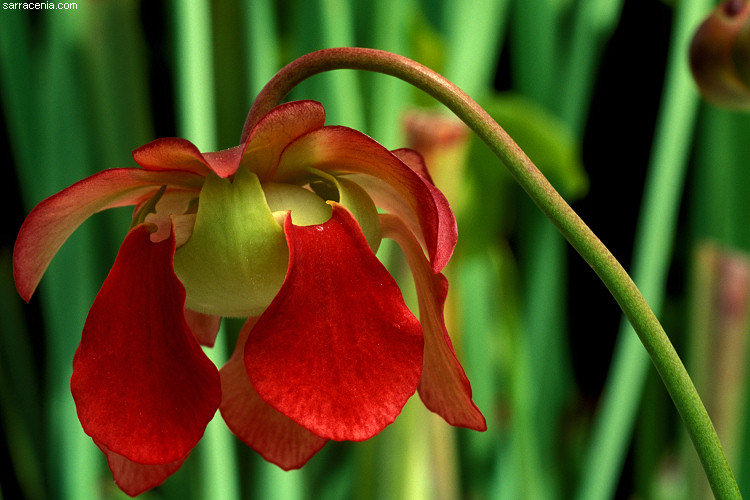
The flowers of S. alabamensis are essentially identical to those of
S. rubra, and therein rages a controversy. However, I think that the two
S. alabamensis subspecies are similar enough to each other, and different enough from
S. rubra to merit separation.
If you are really interested in this kind of discussion, take a look at my
comments on S. rubra and
S. jonesii, since they are involved in the controversy.
For your interest, here are the opinions of a few famous botanists regarding S. alabamensis:
Fred and Roberta Case (1976)---considered this a separate species.
Sidney McDaniel (1971)---did not think this merited any kind of name.
Don Schnell (2002a, 2011)---maintained this as a subspecies of S. rubra.
Larry Mellichamp (2011)--considered this a separate species, as in Flora of North America.
Sarracenia alabamensis subsp. alabamensis
This subspecies is found only in central Alabama, in Autauga and Chilton Counties. It used to
occur in Elmore County, but apparently it is now extinct there now.
It is found in about twelve sites in these two counties. When I say "about 12", it is
not like there is a big uncertainty---every S. alabamensis site is heavily studied and carefully managed by State and
Federal agencies as well as by numerous scientific teams. However, there is no uniform agreement among
all these players as to whether some
of the closely spaced populations should be referred to as a single or separate sites.
This plant's common name is the cane-brake pitcher plant, indicating that the plant is sometimes associated with cane-brake
plant communities.
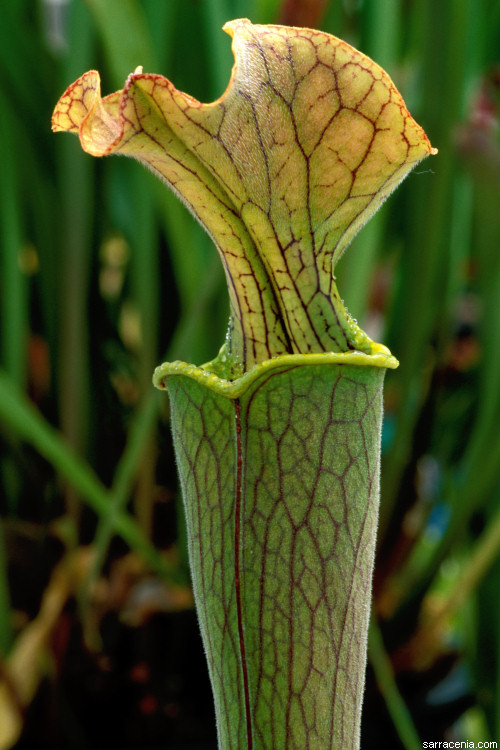
Sarracenia alabamensis subsp. alabamensis
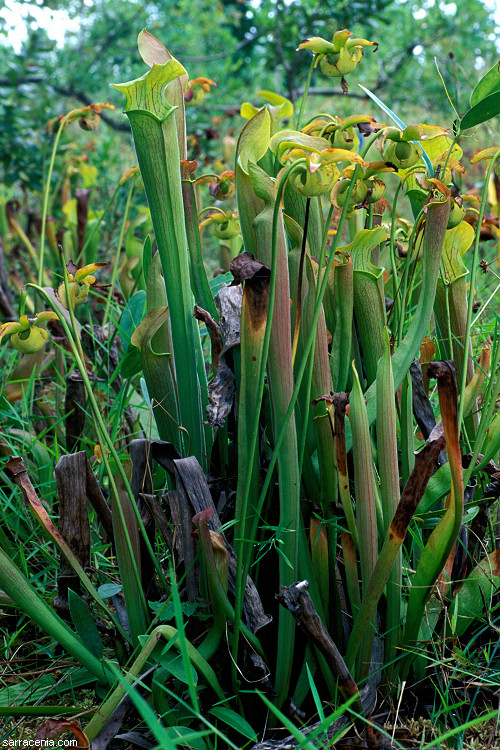
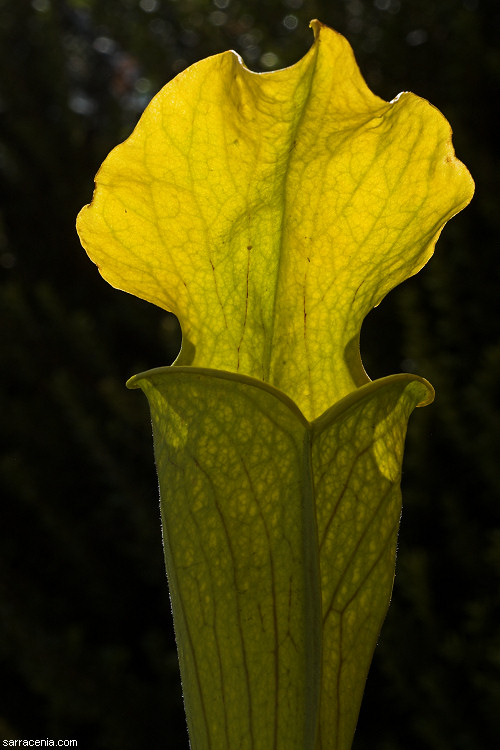
is a tall, mostly green pitcher plant with reddish veins. Plants are often
pubescent. The pitcher column is broad and not very tall. Some specimens are very colorful, especially in the fall or
when the plants are juveniles.
The species looks much like Sarracenia alata, but the flowers of
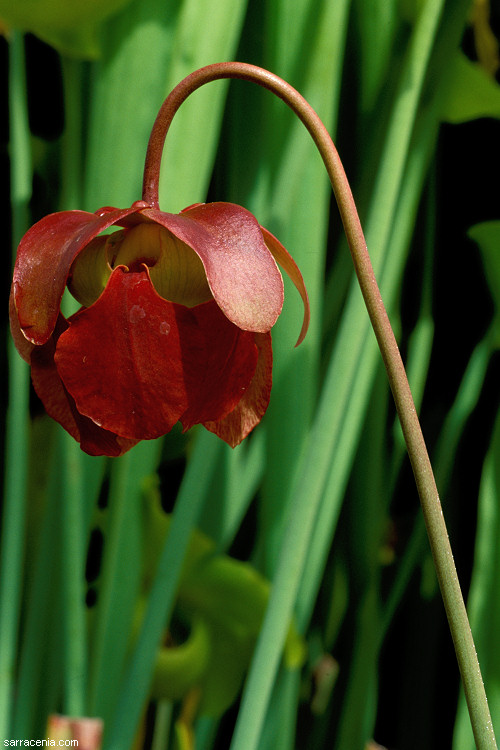
S. alabamensis are bright reddish-purple and scented like raspberries, while the flowers of
S. alata are pale and unscented.
Unless you are working as a conservationist, botanist, or ecologist, it is unlikely you will be able
to see these plants in the wild. Sites have so often been poached by horticulturists that
conservationists have stopped telling people how to visit them.
Essentially, hobbyists have demonstrated that they (or at least some of them)
are not to be trusted. This is really unfortunate.
I have had the pleasure of visiting six sites, but in these cases I
was led there by the site owners or managers. If you visit S. alabamensis subsp.
alabamensis sites and do not have permission from
the landowners, you are trespassing. Trespassers can be attacked by farm dogs, get shot at, or get arrested. I am not joking.
It is often difficult to obtain specimens of this plant, because the species is protected by Federal and International
conservation laws.
The plant is listed as "Endangered" on the US Endangered Species Act. This means there are restrictions
to selling the plant across state lines in the USA. See the FAQ information on
restrictions from the Endangered Species Act.
Sarracenia alabamensis subsp. alabamensis
is also listed on Appendix I of the CITES appendix. This means
there are major restrictions on international trade of the plant. Read about these here.
Since there are so many hurdles in obtaining these plants legally, in 2003 the International Carnivorous Plant Society
distributed seedlings from three sources, with permits from the US Fish & Wildlife Service, in an attempt to decrease
poaching interest. More about the sites they came from can be learned here.
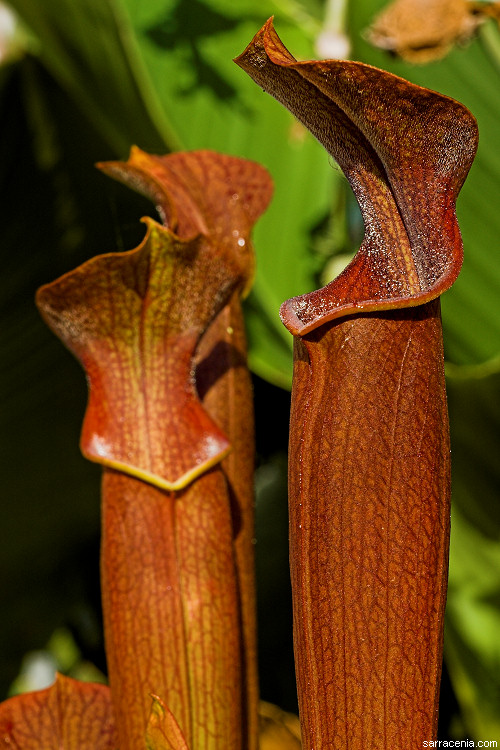
Sarracenia alabamensis subsp. wherryi
This subspecies, named after the famous botanist E.T. Wherry, is commonly found with
Sarracenia leucophylla, although hybrids are rare. In essence, this plant looks like a
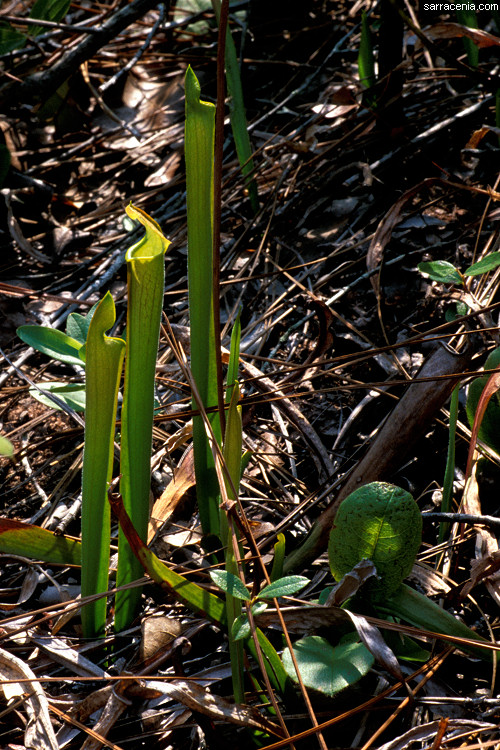
short version (8-45 cm, average 18 cm tall) of the taller Sarracenia alabamensis subsp.
alabamensis (18-71 cm, average 40 cm tall). Very pubescent plants are common.
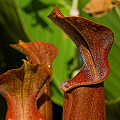 "Chatom giant"
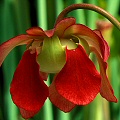 S. a. subsp. wherryi
 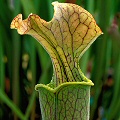 S. a. subsp. wherryi
  S. a. subsp. wherryi
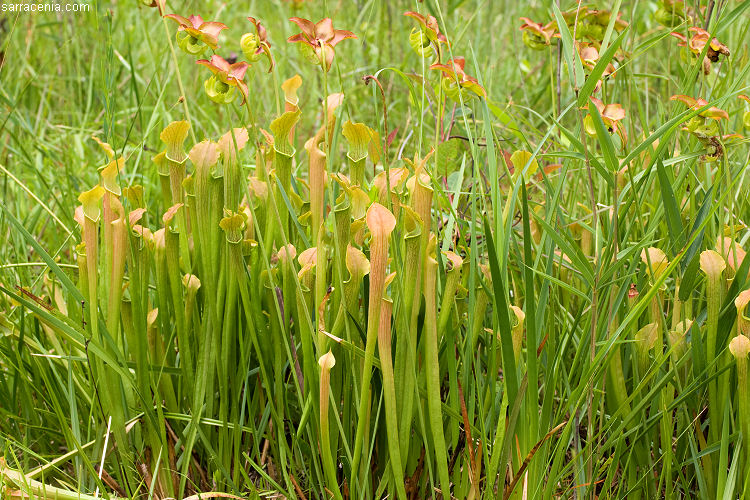
A few interesting variants exist of this plant. I have heard both of anthocyanin-free plants, and regularly pigmented plants
but with yellow to yellow-orange flowers. However, actual evidence of such plants has never reached past the Bigfoot stage.
Particularly large plants from Chatom, Alabama, are prized by horticulturists.
Unfortunately they return the favor by calling the plants things like "Chatham giant", "Chathom giant",
"Charthom giant", and "Chathalm giant."
Sarracenia alabamensis subsp. wherryi occurs near
where the Alabama and Tombigbee rivers meet, in southwestern
Alabama (Washington, Mobile, Baldwin; any others?)
and eastern Mississippi (Greene and Wayne Counties), and Florida (western Escambia County).
Page citations: Case, F.W., and Case, R.B. 1974, 1976;
CITES, 1992; Determann, R. 2000, private communication; McDaniel, S. 1971;
McPherson, S. & Schnell, D. 2011; Murdock, N. 2000, private communication;
Rice, B.A. 2001a, 2003a, 2006a, 2018, 2019; Schnell, D.E. 2002a; US Fish & Wildlife Service, 1973; personal observations.


