Q: Sarracenia species lists
A: Now we come to something that causes endless arguments---which entities in the
genus should be considered species? Scientists today conclude there are anywhere from eight to eleven species.
The disagreement depends upon their species concepts; their scientific schools of thought; the type of research they use to
form their opinions; who their graduate advisors were;
and good old politics and personal animosities! (Oops, maybe I should not admit that here...)
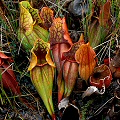 S. gibbosa??
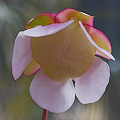 S. rosea??
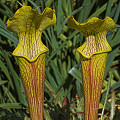 S. alabamensis??
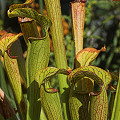 S. jonesii??
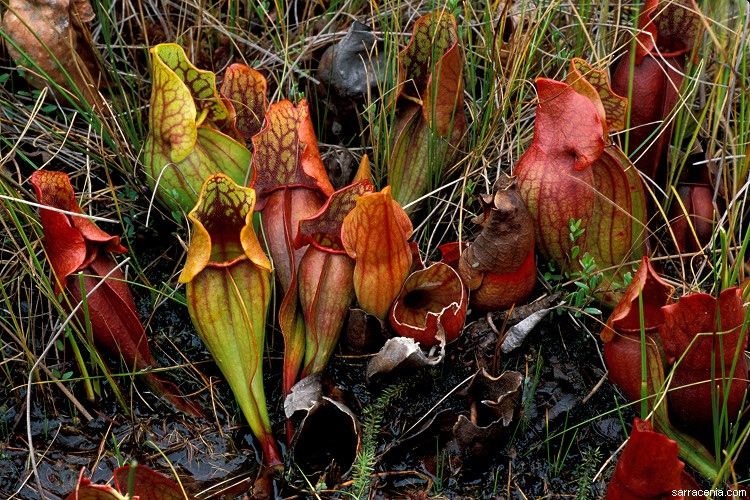
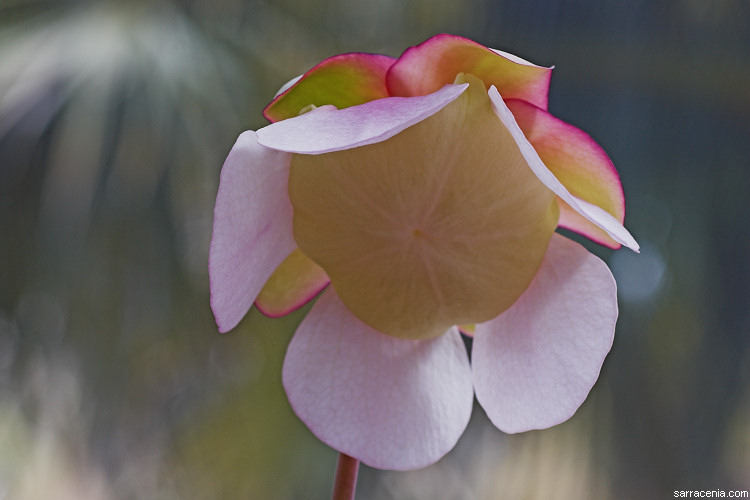
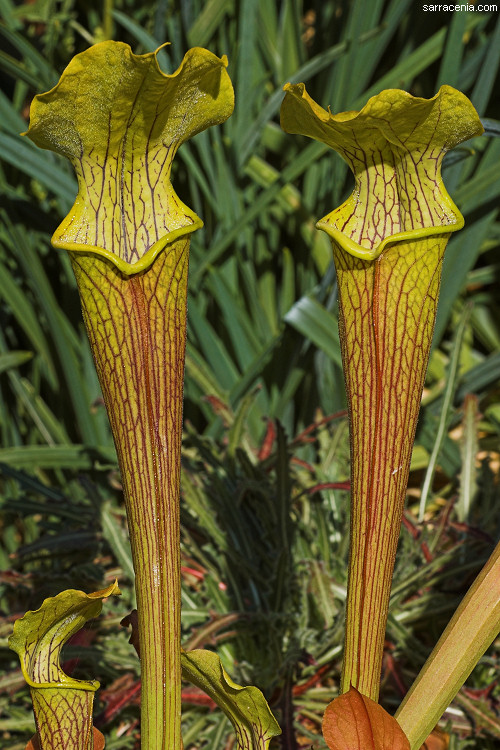
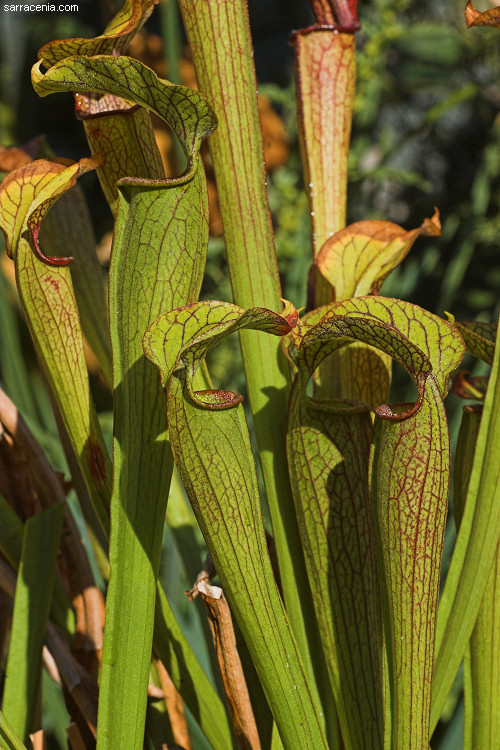
Currently there is no clear consensus on how the species within Sarracenia should be classified. There are
two main areas of difficulty. The first centers upon Sarracenia rubra. One perspective, championed in
particular by Don Schnell, is that this species has five subspecies. Another perspective, as promoted in the Sarraceniaceae portion of
the Flora of North America (penned by Larry Mellichamp), is that two of the subspecies should be elevated to separate
species (S. alabamensis, S. jonesii). There is a question of whether
subsp. wherryi should be assigned to S. rubra or the
proposed S. alabamensis. Furthermore, some botanists (in older publications)
have maintained that subsp. gulfensis should not be given
subspecies status at all. Finally, there are populations of plants in central Georgia and a bit of South Carolina that--while frequently mentioned in the literature,
were not recognized at all until recently, when I gave them subspecific status.
The second controversy
focuses on Sarracenia rosea, and whether it should be a separate species from
Sarracenia purpurea. Also, the Flora of North America treatment does not
consider Sarracenia purpurea var. montana valid.
Associated with all this is some confusion about how the north and south
subspecies of Sarracenia purpurea should be designated. (This should not be a problem, really, since
it has been resolved, but it takes a while for the news to get around.)
Read the pages that follow for more details
on these entities.
There is a third, bonus controversy... What's the deal about all these varieties? Are they really relevant? I will let you read my comments in the
pages for each species.
Let us first look at the list of taxa that I tend to follow. It is
similar to the perspective given in the Flora of North America. In this list, I
have inserted the new taxa from McPherson & Schnell (2011). I have also diverged from the FNA treatment by
including the controversial
S. purpurea subsp. venosa var. montana and also the more recently described
S. rubra subsp. viatorum.
- Sarracenia alabamensis Case & R.B.Case
- S. alabamensis subsp. wherryi Case & R.B.Case
- Sarracenia alata (Wood) Wood
-
-
- S. alata var. alata f. viridescens S.McPherson & D.E.Schnell
-
-
- S. alata var. atrorubra S.McPherson & D.E.Schnell
- S. alata var. cuprea S.McPherson & D.E.Schnell
- S. alata var. nigropurpurea P.D'Amato ex S.McPherson & D.E.Schnell
- S. alata var. ornata S.McPherson & D.E.Schnell
- S. alata var. rubrioperculata S.McPherson & D.E.Schnell
-
- Sarracenia flava L.
-
-
- S. flava var. flava f. viridescens S.McPherson & D.E.Schnell
-
-
- S. flava var. atropurpurea (Hort.Bull) Bell
- S. flava var. cuprea D.E.Schnell
- S. flava var. maxima Hort.Bull ex Mast.
- S. flava var. ornata Hort.Bull ex Mast.
- S. flava var. rubricorpora D.E.Schnell
- S. flava var. rugelii (Shuttlew. ex A.DC.) Mast.
-
- Sarracenia jonesii Wherry
-
-
- S. jonesii f. viridescens (S.McPherson & D.E.Schnell) B.Rice (pub. in press)
-
-
- Sarracenia leucophylla Raf.
-
-
- S. leucophylla var. leucophylla f. viridescens S.McPherson & D.E.Schnell
-
-
- S. leucophylla var. alba (Hort.T.Baines ex R.Hogg & T.Moore) J. Pietropaolo & P. Pietropaolo ex S.McPherson & D.E.Schnell
-
- Sarracenia minor Walt.
-
-
- S. minor var. minor f. viridescens S.McPherson & D.E.Schnell
- S. minor var. okefenokeensis D.E.Schnell
-
-
- Sarracenia oreophila (Kearney) Wherry
-
- S. oreophila var. ornata S.McPherson & D.E.Schnell
-
- Sarracenia psittacina Michx.
-
-
- S. psittacina var. psittacina f. viridescens S.McPherson & D.E.Schnell
- S. psittacina var. okefenokeensis S.McPherson & D.E.Schnell
- S. psittacina var. okefenokeensis f. luteoviridis S.McPherson & D.E.Schnell
-
-
- Sarracenia purpurea L.
-
-
- S. purpurea subsp. purpurea f. heterophylla (Eaton) Fern.
-
- S. purpurea subsp. venosa (Raf.) Wherry
-
- S. purpurea subsp. venosa f. pallidiflora S.McPherson & D.E.Schnell
- S. purpurea subsp. venosa var. montana D.E.Schnell & Determann
-
-
- Sarracenia rosea Naczi, Case & R.B.Case
-
-
- S. rosea f. luteola (Hanrahan & Miller) Naczi, Case & R.B.Case
-
-
- Sarracenia rubra Walt.
- S. rubra subsp. gulfensis D.E.Schnell
-
- S. rubra subsp. gulfensis f. luteoviridis S.McPherson & D.E.Schnell
-
- S. rubra subsp. viatorum B.Rice
- S. rubra subsp. gulfensis D.E.Schnell
A second perspective is clearly argued in McPherson & Schnell (2011):
- Sarracenia alata (Wood) Wood
-
-
- S. alata var. alata f. viridescens S.McPherson & D.E.Schnell
-
-
- S. alata var. atrorubra S.McPherson & D.E.Schnell
- S. alata var. cuprea S.McPherson & D.E.Schnell
- S. alata var. nigropurpurea P.D'Amato ex S.McPherson & D.E.Schnell
- S. alata var. ornata S.McPherson & D.E.Schnell
- S. alata var. rubrioperculata S.McPherson & D.E.Schnell
-
- Sarracenia flava L.
-
-
- S. flava var. flava f. viridescens S.McPherson & D.E.Schnell
-
-
- S. flava var. atropurpurea (Hort.Bull) Bell
- S. flava var. cuprea D.E.Schnell
- S. flava var. maxima Hort.Bull ex Mast.
- S. flava var. ornata Hort.Bull ex Mast.
- S. flava var. rubricorpora D.E.Schnell
- S. flava var. rugelii (Shuttlew. ex A.DC.) Mast.
-
- Sarracenia leucophylla Raf.
-
-
- S. leucophylla var. leucophylla f. viridescens S.McPherson & D.E.Schnell
-
-
- S. leucophylla var. alba (Hort.T.Baines ex R.Hogg & T.Moore) J. Pietropaolo & P. Pietropaolo ex S.McPherson & D.E.Schnell
-
- Sarracenia minor Walt.
-
-
- S. minor var. minor f. viridescens S.McPherson & D.E.Schnell
- S. minor var. okefenokeensis D.E.Schnell
-
-
- Sarracenia oreophila (Kearney) Wherry
-
- S. oreophila var. ornata S.McPherson & D.E.Schnell
-
- Sarracenia psittacina Michx.
-
-
- S. psittacina var. psittacina f. viridescens S.McPherson & D.E.Schnell
- S. psittacina var. okefenokeensis S.McPherson & D.E.Schnell
- S. psittacina var. okefenokeensis f. luteoviridis S.McPherson & D.E.Schnell
-
-
- Sarracenia purpurea L.
-
-
- S. purpurea subsp. purpurea f. heterophylla (Eaton) Fern.
-
- S. purpurea subsp. venosa (Raf.) Wherry
-
- S. purpurea subsp. venosa f. pallidiflora S.McPherson & D.E.Schnell
- S. purpurea subsp. venosa var. montana D.E.Schnell & Determann
- S. purpurea subsp. venosa var. burkii D.E.Schnell
- S. purpurea subsp. venosa var. burkii f. luteola Hanrahan & Miller
-
-
- Sarracenia rubra Walt.
- S. rubra subsp. alabamensis (Case & R.B.Case) S.McPherson & D.E.Schnell
- S. rubra subsp. gulfensis D.E.Schnell
-
- S. rubra subsp. gulfensis f. luteoviridis S.McPherson & D.E.Schnell
-
- S. rubra subsp. jonesii (Wherry) Wherry
-
- S. rubra subsp. jonesii f. viridescens S.McPherson & D.E.Schnell
-
- S. rubra subsp. wherryi (Case & R.B.Case) D.E.Schnell
- S. rubra 'Incompletely diagnosed taxon from Georgia and South Carolina’
You will notice a weird non-standard name lurking amongst the Sarracenia rubra taxa, which I dealt with
in 2018--see the Sarracenia rubra page
for more on that.
So what is the answer? Which list is "correct? " Is either?
In order to form a firm, reliable, and authoritative opinion about these matters, a scientist should
spend a huge amount of time in the field studying these plants in great detail. I do not mean just a few trips---I mean a lot
of field time. Looking at plants in cultivation
does not count for much. In fact, studying cultivated plants can even be misleading, since the specimens in cultivation are
often plants selected by horticulturists because they are abnormal!
A combination of field time and molecular
results can reveal relationships to help guide thought, but in the end you must examine the plants in the wild setting to
judge the differences between, and commonalities joining, different populations of plants.
To make things even more confounding,
I think that the modern botanist has another problem facing him or her. Specifically, anthropogenic
land destruction has
caused so much fragmentation of Sarracenia populations
that modern botanists are presented with a skewed vision of how
Sarracenia vary across the landscape. Where there were once great populations of plants across the southern
US, there is now urban sprawl interspersed with scattered pitcher plant sites. The separate populations may look suggestively
different from each other, but that is because the intervening sites---which may have had plants of intermediate character---have been
destroyed. There may be an artificially enhanced appearance of distinct types of Sarracenia which is just an
artifact of human development. Think about that, ye armchair taxonomists!
Ultimately, my interest is not so much in taxonomy as it is in conservation, so I am not going to defend any
nomenclatural perspective with enormous vigor.
My interest is just in trying to protect these entities from extinction. Call them what you will; our energies should
be focused on keeping them alive in the wild.
Page citations: McPherson, S. & Schnell, D. 2011;
Mellichamp, L. (Sarracenia, in eFlora (2008), accessed 2012); Rice, B.A. 2006a, 2018, 2019; Schnell D.E. 1976, 2002a.


