| The Sarracenia rubra-complex |
|---|
| Scheme #1: Case & Case |
|
S. rubra Walt. subsp. rubra1 S. jonesii Wherry S. alabamensis Case & Case S. alabamensis subsp. wherryi Case & Case |
| Scheme #2: Schnell |
|
S. rubra Walt. subsp. rubra2 S. rubra subsp. gulfensis Schnell S. rubra subsp. jonesii (Wherry) Wherry S. rubra subsp. alabamensis (Case & Case) S.McPherson & D.E.Schnell S. rubra subsp. wherryi (Case & Case) Schnell S. rubra 'Incompletely diagnosed taxon from Georgia and South Carolina’ |
| Scheme #3: common current usage |
|
S. rubra Walt. subsp. rubra2 S. rubra subsp. gulfensis Schnell S. jonesii Wherry S. alabamensis Case & Case S. rubra subsp. wherryi (Case & Case) Schnell S. rubra "Ancestral form" |
| Scheme #4: progressive view |
|
S. rubra Walt. subsp. rubra2 S. rubra subsp. gulfensis Schnell S. rubra subsp. viatorum B.Rice S. jonesii Wherry S. alabamensis Case & Case S. alabamensis subsp. wherryi Case & Case |
|
1This sensu lato definition includes the Gulf Coast plants, and also plants of central Georgia and some parts of South Carolina. 2This sensu stricto definition excludes the Gulf Coast plants. |
Q: About Sarracenia rubra, Sweet's sweet pitcher plant
and Schnell's pitcher plant
A: This is the last species for us to discuss, but perhaps it is the most controversial.
Even this plant's common name is a source of discussion. Some think the name "sweet pitcher plant" indicates the nice smell that
the red flowers have. Others think the plant was named after a botanist; proponents of such a view use a capital S when writing
"Sweet's pitcher plant." I do not care either way.
The Latin word rubra means red.
Like
S. purpurea and S. rosea, S. rubra
has a highly controversial taxonomy. The best way to proceed is to delve right into the argument and
see where that takes us. I will start by describing how different people divide the species, and I will
unabashedly tell you my thoughts on the different schemes.
Scheme #1 follows the perspectives of Case & Case, who argue very clearly and
nicely for their interpretations.
- Scheme #1: Case & Case
- Sarracenia rubra Walt.
- Sarracenia jonesii Wherry
- Sarracenia alabamensis Case & Case subsp. alabamensis
- S. alabamensis subsp. wherryi Case & Case
Notice that this scheme includes only four entities, and the Florida Gulf Coast plants are considered simply
part of the natural variation of S. rubra.
While I like many of the things in this system, I differ because that I see the Florida
Gulf Coast plants are significantly different from the Atlantic Coast plants, and they do not seem properly
acknowledged using this system.
Scheme #2 is the perspective proposed and used by Don Schnell. He does not believe that S. alabamensis or
S. jonesii should be considered separate species, and reduces them to subspecies status.
- Scheme #2: Schnell, McPherson & Schnell
- Sarracenia rubra Walt.
- Sarracenia rubra subsp. alabamensis (Case & Case) S.McPherson & D.E.Schnell
- Sarracenia rubra subsp. gulfensis Schnell
- Sarracenia rubra subsp. jonesii (Wherry) Wherry
- Sarracenia rubra subsp. wherryi (Case & Case) D.E.Schnell
- Sarracenia rubra 'Incompletely diagnosed taxon from Georgia and South Carolina’
In
doing so, he retains the "wherryi" plants at the subspecies level, but now under
S. rubra. Also, notice that he has pulled the Florida
Gulf Coast plants out of the more broadly defined
S. rubra concept that the Cases used, and called them
subsp. gulfensis. This is a very workable system too.
My only significant criticism of this method is the addition of a final plant, deeply described in McPherson & Schnell (2011), which the authors
all but validate as a new taxon. However, they opted not to, for reasons I do not quite understand (see below). This plant is instead given the working title, Sarracenia rubra 'Incompletely diagnosed taxon from Georgia and South Carolina’, which I think we can all agree is pretty unsatisfactory.
(One detail--due to an error in Latin name publications,
"Sarracenia rubra subsp. alabamensis" was not properly established as
a name until S.McPherson & D.E.Schnell (2011). You may see it referred to, in older publications, by the incorrect name
"Sarracenia rubra subsp. alabamensis (Case & Case) D.E.Schnell"--note the
minor change in authorities at the end of the name.)
Until September 2008, I used the plant names given in Scheme #3.
- Scheme #3: Common current usage
- Sarracenia alabamensis Case & Case
- Sarracenia jonesii Wherry
- Sarracenia rubra Walt.
- Sarracenia rubra subsp. gulfensis Schnell
- Sarracenia rubra subsp. wherryi (Case & Case) Schnell
- Sarracenia rubra "Ancestral form"
This system
draws on some of the strengths of both Case & Case and Schnell. This is a very current common usage, and is for the most part the system
I used in my 2006 book. As for the
Sarracenia rubra 'Incompletely diagnosed taxon from Georgia and South Carolina’ in Scheme #2, I largely ignored it. Basically,
I was waiting for the East Coast botanists to sort that whole thing out, and in the meantime, I would refer to it by the name "Ancestral
form", not really because I thought it was truly the ancestor of any modern form, but rather just because that name was in more common
usage. (For example, I have judged plant shows where I saw this plant entered with the name "Ancestral form"--I've never seen anyone
use the more cumbersome name promoted by McPherson & Schnell (2011).)
However, I now use the system given in Scheme #4.
- Scheme #4: My progressive view
- Sarracenia alabamensis Case & Case
- Sarracenia alabamensis subsp. wherryi Case & Case
- Sarracenia jonesii Wherry
- Sarracenia rubra Walt.
- Sarracenia rubra subsp. gulfensis Schnell
- Sarracenia rubra subsp. viatorum B.Rice
This scheme
acknowledges that the "wherryi" plants look a lot like
S. alabamensis, and reflects the fact that they are in the same large drainages, i.e.
"wherryi" is downriver of S. alabamensis.
Also, I took the step of selecting a type specimen and publishing a paper that finally assigned a name to the
Sarracenia rubra 'Incompletely diagnosed taxon from Georgia and South Carolina’, calling it
Sarracenia rubra subsp. viatorum.
All these proposed schemes aside, I must emphasize that my interest is in the
conservation of these plants, whatever you wish to call them. If someone talks to me about
S. rubra subsp. jonesii, I am not going to break the flow of the
conversation to interject my views. In casual conversation, I just call them "jonesii" anyway!
Range (Sarracenia rubra subsp. rubra,
S. rubra subsp. gulfensis,
S. rubra subsp. viatorum
States: North Carolina, South Carolina, Georgia, Florida. (Details for subspecies, given below.)
Subspecies
Some comments on the subspecies are given below. For more on
S. jonesii and
S. alabamensis (including
what you might call S. rubra subsp. wherryi)
refer to their separate FAQ treatments.
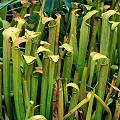 S. r. subsp. rubra
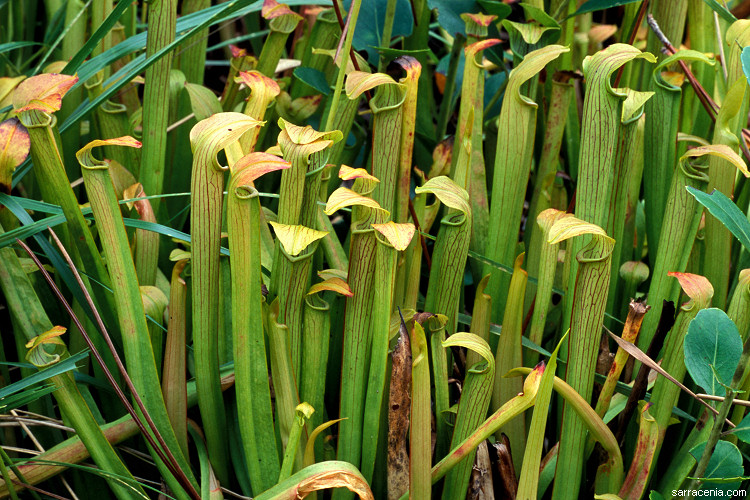
Sarracenia rubra subsp. rubra (sweet pitcher plant):
Using the restricted definition of the
subspecies, as per scheme 4 above, this subspecies is restricted to the coastal plains of North Carolina, South Carolina, and southeastern Georgia.
This is a small plant, and the pitchers are 26-45 cm tall. The ala in front of the pitcher is pronounced, and the lid is long and
narrow. I really like this plant because the veining is very pretty and pinstriped. The pitchers, tall, slender, and erect, evoke
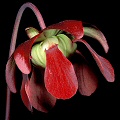
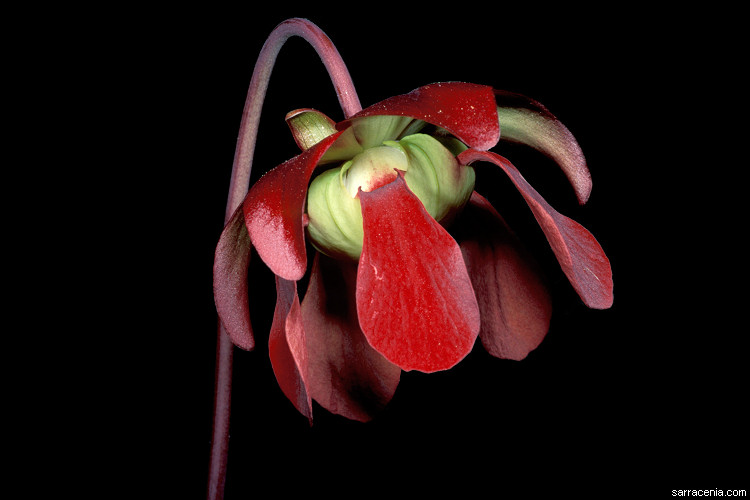
the image of little meerkats or prairie dogs standing upright, looking around. The flowers of this plant, like all those of
the Sarracenia rubra-complex, are small, bright red, and sweet-raspberry smelling. The underside
of the petals are usually green or tan with a central reddish stripe, although the undersides of some flowers are
all-red.
I have read unsubstantiated rumours that an anthocyanin-free form of this plant has been found, but reliable evidence of
such plants have not yet surfaced.
 S. r. subsp. gulfensis
 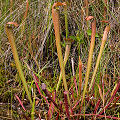 S. r. subsp. gulfensis
  S. r. subsp. gulfensis
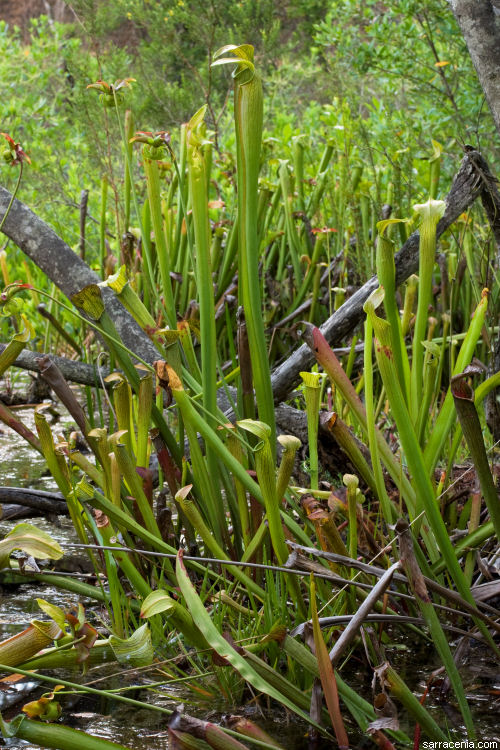
Sarracenia rubra subsp. gulfensis
(Schnell's pitcher plant):
This plant was given subspecies status by Don Schnell to denote the S. rubra subsp.
rubra plants found immediately along the Florida Gulf Coast
(Escambia, Santa Rosa, Okaloosa, Walton Counties). I proudly note that I
had the honor of coining the common name, in honor of Don Schnell.
The pitchers are much larger on average--40-80 cm tall. Some are mostly green with red pinstripes, some are blush-red throughout.
The pitcher often has the bulge in the upper-third of the pitcher that is supposedly so iconic of
Sarracenia jonesii. I have seen extremely large plants
in essentially aquatic conditions, growing on floating vegetation. Very nice.
Anthocyanin-free plants have been found a number of times, for example in
Santa Rosa County (Florida), and have been given the name
Sarracenia rubra subsp. gulfensis f. luteoviridis.
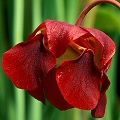 from Taylor Co. GA
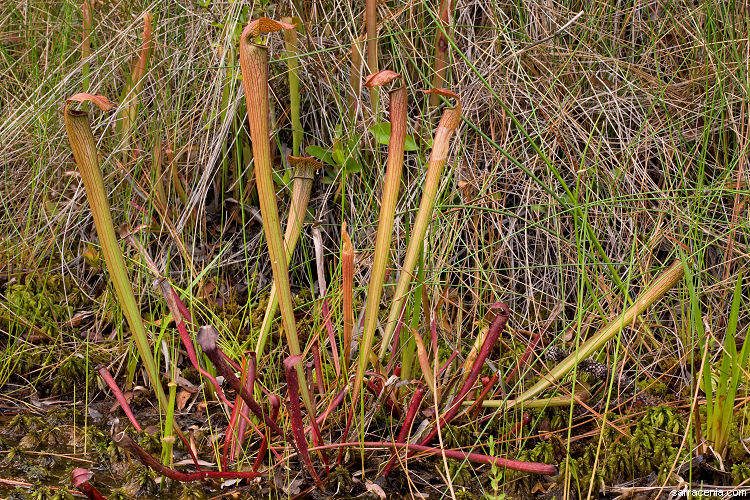
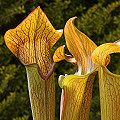 from Taylor Co. GA
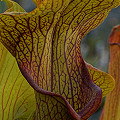 from Taylor Co. GA
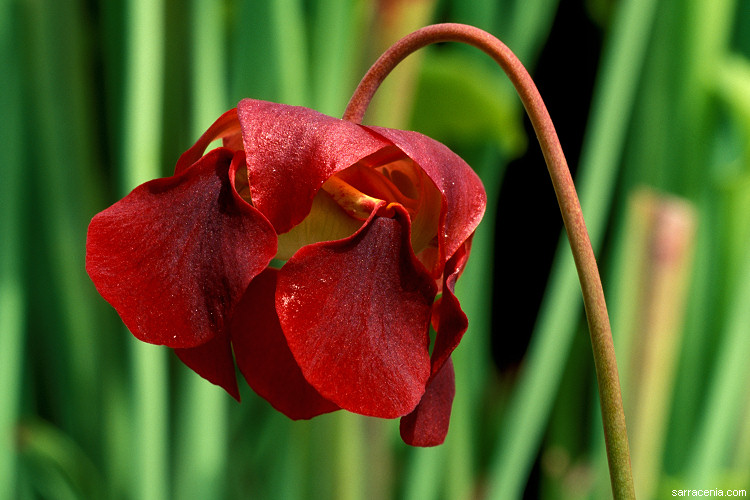
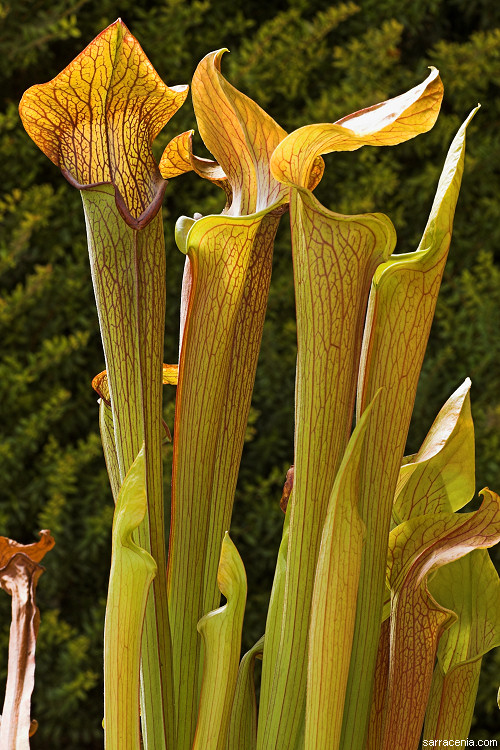
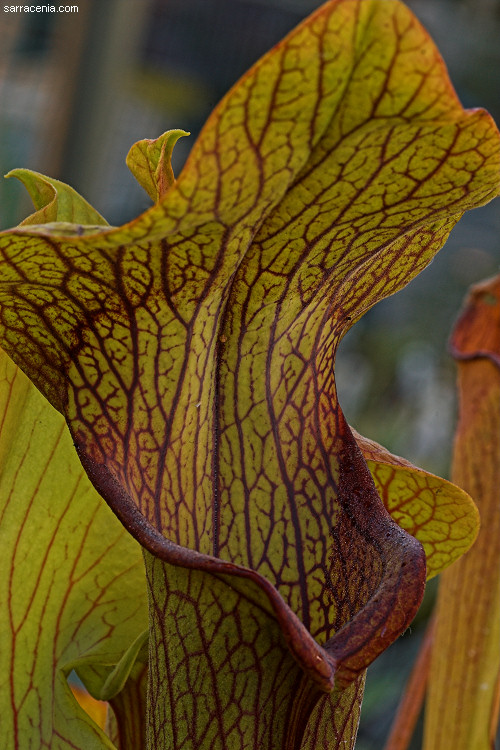
Sarracenia rubra subsp. viatorum
(Ancestral pitcher plant):
In central Georgia, ranging into South Carolina, and mostly
far from other Sarracenia rubra plants, there occurs what appears to be
a strange variant Sarracenia rubra. For years this was called the "Ancestral form"--a name first coined by
Phil Sheridan. In 2011, McPherson & Schnell wrote extensively about this plant, all the while referring to it by the cumbersome name
"Sarracenia rubra 'Incompletely diagnosed taxon from Georgia and South Carolina' ".
I grimaced when I saw that strange name, but shrugged my shoulders, assuming that soon--very soon--someone would step up and simply put a name
on the plant. After all, McPherson & Schnell all but did so themselves, but for some reason did not take the final step.
After several years passed, I finally decided to finish an article I was writing on this plant, and to give it a name. Was this a wise idea? I am not sure--it is not clear to me if the name will survives the rigors of scientific scrutiny. In a few years, it might be reduced to synonymy. However,
at least it will be a reasonable name to use, based in the rules of taxonomy.
The epithet viatorum means traveler, and notes the great range this plant is from its kin subspecies. In deference to the
most commonly used nickname, I suggest the common name "Ancestral form", although really it is common usage that will determine the
common name!
Generally speaking this plant differs from Sarracenia rubra subsp. gulfensis in having
shorter (up to 45 cm) tall pitchers, compared to 60-80 cm pitchers for S. r. subsp. gulfensis.
The pitcher tends to be more pubescent, and the lid tends to gape upwards more steeply.
Conservation issues
All these Sarracenia rubra subspecies face many of the same
conservation pressures. Habitat destruction, fragmentation, and
degradation from the usual sources (development, altered hydrology and fire regimes, pollution, invasive species, poaching)
are contributing to their rapid decline. Many sites in Florida that only twenty years ago were considered fabulous are now just
strips of homes and strip malls. Does anyone remember the Yellow River sites?
Page citations: Case, F.W. & Case, R.B. 1974, 1976;
Kartesz, J. et al. 2009 (BONAP); McDaniel, S. 1971; McPherson, S. 2006;
McPherson, S. & Schnell, D.E. 2011; Rice, B.A. 2006a, 2018;
Schnell, D.E. 1977, 1978a, 1978b, 1979, 2002a;
Sheridan, P. & Scholl, B. 1993; USDA NRCS. 2007; personal observations.


