| More Temperate and Arctic Pinguicula | |
|---|---|
| Affixed hibernacula | |
| Subgen. Temnoceras sect. Micranthus | |
| P. alpina | Spain, France, Switzerland, Austria, Italy, Slovenia, Germany, Poland, Slovakia, Romania, Norway, Sweden, Finland, Russia, India, Nepal, China |
| Subgen. Temnoceras sect. Nana | |
| P. algida | Russia |
| P. ramosa | Japan |
| P. spathulata | Russia (Siberia) |
| (P. variegata) | Russia |
| P. villosa1 | USA, Canada, Sweden, Norway, Finland, Russia, China, North Korea |
| Loose hibernacula | |
| Subgen. Pinguicula sect. Pinguicula | |
| P. apuana | Italy |
| P. arvetii | France, Italy |
| P. balcanica subsp. balcanica | Bosnia/Herzegovina, Yugoslavia, Macedonia, Albania, Greece, Bulgaria |
| P. balcanica subsp. pontica | Turkey |
| P. bohemica | Czech Republic |
| P. caussensis | France |
| P. christinae | Italy |
| P. corsica | Corsica (France) |
| P. dertosensis | Spain |
| P. fiorii | Italy |
| P. fontiqueriana | Morocco |
| P. grandiflora subsp. grandiflora | Ireland, Morocco?, Spain, France, Switzerland |
| P. grandiflora subsp. rosea | France |
| P. leptoceras | Switzerland, Austria, Italy, France |
| P. longifolia | Spain, France |
| P. macroceras | Japan, Russia, w USA, w Canada |
| P. mariae | Italy |
| P. mundi | Spain |
| P. nevadensis | Spain |
| P. reichenbachiana | France, Italy |
| P. poldinii | Italy |
| P. vallisneriifolia | Spain |
| P. vallis-regiae | central Italy |
| P. vulgaris | Canada, USA, Iceland, Foroyar, Ireland, United Kingdom, Norway, Sweden, Finland, Russia, Denmark, Belgium, The Netherlands, Germany, Poland, Czech Republic, Slovakia, France, Switzerland, Liechtenstein, Austria, Hungary, Romania, Portugal, Spain, Italy, Slovenia, Croatia, Morocco |
|
1Possibly with loose hibernacula. |
|
Q: Temperate and Arctic species Pinguicula
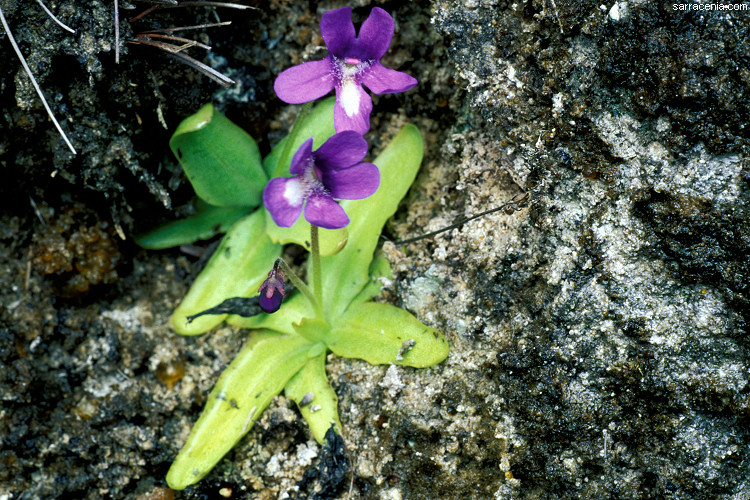
Pinguicula fiorii
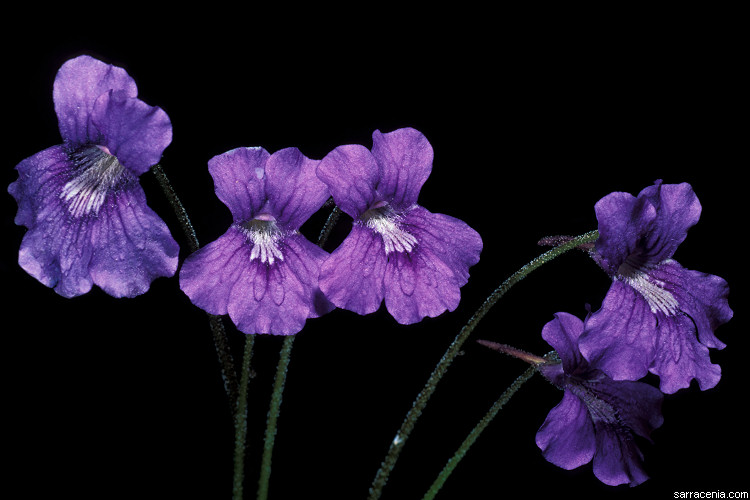
Pinguicula grandiflora
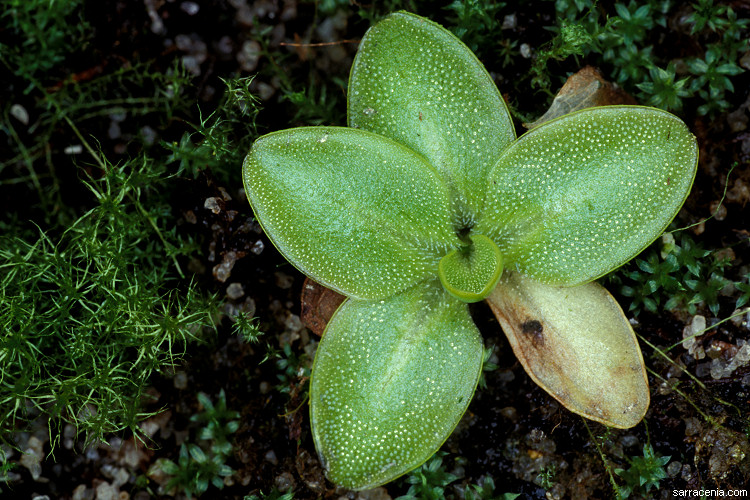
Pinguicula leptoceras
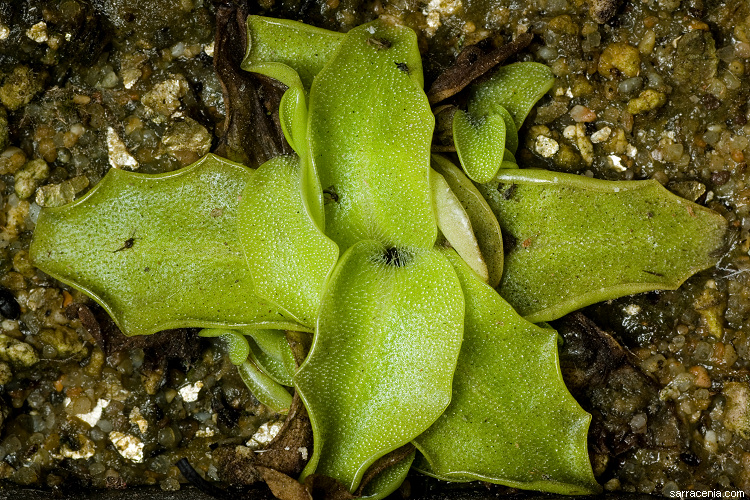
Pinguicula longifolia
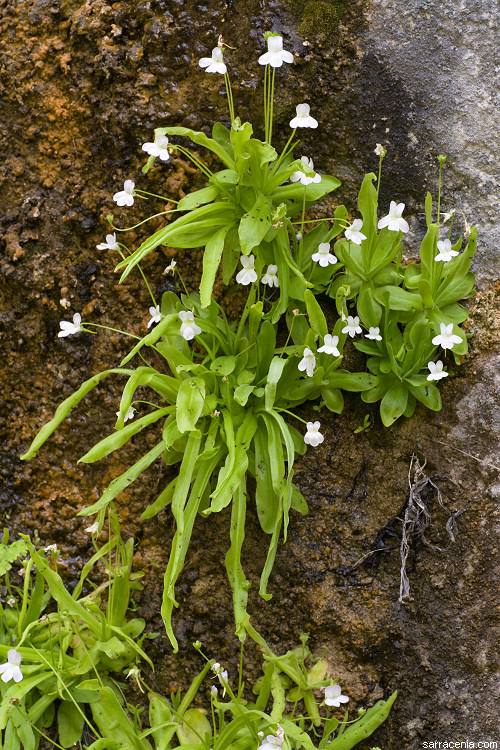
Pinguicula vallisneriifolia
A: These are all plants of cold climates that survive the cold winters by making
tight little buds called hibernacula. These tight buds are usually loosely attached to the ground, and detach readily.
Once detached, they float with the spring melt waters, dispersing plant propagules. A smaller number of
species have hibernacula that are tightly attached to the soil surface.
Most of the Pinguicula species on this page are somewhat challenging to grow, as they have
winter dormancy requirements which must be respected. Furthermore, their flowers are for the most part relatively small and
not amazingly showy. Still, I think their flowers have a healthy dose of beauty dust, and I like these plants a great
deal.
I have discussed Pinguicula macroceras, Pinguicula villosa, and
Pinguicula vulgaris on the previous web page, but comments on some of the other species
follow.
Changes from 2016-2018
Subgenus Temnoceras section Micranthus is reduced to a single species.
Subgenus Temnoceras section Nana grew with the addition of three species, although
P. variegata was absorbed into P. spathulata.
Subgenus Pinguicula section Pinguicula is expanded by
the addition of P. arvetii, P. bohemica,
P. christinae, and P. fontiqueriana. Also,
three P. longifolia subspecies were elevated to species status.
Pinguicula apuana
Very similar to P. vulgaris, but with a larger
corolla with longer spur, and with a two-parted white palate patch. This seems to me a fairly unimpressive set of arguments,
but I bow to the expertise of the secondary author (Jost Casper) of the describing paper.
Pinguicula balcanica
Casper described a variety
(P. balcanica var. tenuilaciniata Casper), although
not much is known about this plant.
Pinguicula grandiflora
This species is one of the easier to maintain in cultivation,
and has large, colorful flowers. Pinguicula grandiflora subsp.
rosea) has light pink flowers.
Other floral variants have been named: P. grandiflora f.
pallida (Gaudin) Casper has pale blue flowers, and
P. grandiflora f.
chionopetra E.C.Nelson has pale white flowers.
Pinguicula longifolia
This is a plant which is a source of great arguments. A previous
perspective was that it should be considered to have four subspecies:
P. l. subsp. longifolia,
P. l. subsp. caussensis,
P. l. subsp. dertosensis, and
P. l. subsp. reichenbachiana.
Pinguicula ramosa
This small Japanese species is remarkable in having forked inflorescences.
This occasionally occurs in other species, but never regularly.
Pinguicula spathulata
This plant has absorbed
Pinguicula variegata, as noted above.
Pinguicula spathulata var. variegata
(Turcz.) A.P.Khokhryakov & V.B.Kuvaev is listed as a synonym of Pinguicula alpina in error.
Pinguicula vallisneriifolia
This plant has long, almost stringlike leaves. The species
name notes that the plant has leaves (foliage) like those of Vallisneria (eelgrass).
Page citations: Ansaldi, M., and Casper, J. 2009; Casper, J. 1966;
Lampard, S. et al. 2016;
Partrat, E. 2001; Rice, B. 2006a; Roccia, A. et al. 2016; Schlauer, J. 2002.


