| Species from other areas | |
|---|---|
| Lowlanders | Lowland-highland |
|
N. andamana1 N. biak19 N. chang1 N. distillatoria2 N. halmahera18 N. holdenii3 N. kampotiana4 N. kerrii1 N. kongkandana1 N. krabiensis1 N. madagascariensis5 N. masoalensis5 N. orbiculata1 N. parvula7 N. pervillei6 N. rosea1 N. rowanae7 N. suratensis1 N. tenax7 N. thai1 N. thorelii8 N. vieillardii9 |
N. ampullaria1,10 N. bokorensis3 N. gracilis11 N. gymnamphora12,13 N. khasiana14 N. mirabilis15 N. rafflesiana16 N. sanguinea11,17 N. smilesii4 N. weda18 |
|
Note: I do not work very hard to maintain complete lists of all the islands or countries where these species occur; consider the species list to be fairly complete, but the location of occurence information to be incomplete. 1Thailand. 2Sri Lanka. 3Cambodia. 4Cambodia, Thailand, Vietnam, Laos. 5Madagascar. 6Seychelles. 7Australia. 8Vietnam. 9New Caledonia. 10In Borneo, Maluku, Sumatra, Thailand, Peninsular Malaysia, Singapore, New Guinea. 11In Borneo, Peninsular Malaysia, Singapore, Sulawesi, Sumatra, Thailand. 12Sumatra, Java. 13Includes N. pectinata and N. xiphioides. 14India (Khasia hills, Mt.Jyntea). 15In Borneo, Sumatra, Thailand, Peninsular Malaysia, Sulawesi, Maluku, New Guinea, Australia, Philippines, Java, Indo-China, China, Hong Kong, Macau, Palau. Includes N. mirabilis var. globosa in Thailand. 16Borneo, Sumatra, Peninsular Malaysia, Singapore. 17Also in Peninsular Malaysia. 18Maluku Islands. 19Biak (Schouten Islands). |
|
Q: Nepenthes: species from other parts of the world
A: Most Nepenthes species occur in the main areas of
biodiversity (i.e. Borneo, Sumatra, Peninsular Malaysia, Philippines, New Guinea, Waigeo, Sulawesi)
discussed in the previous FAQ pages. However, a few species
occur out of those ranges--they are listed in the table on this page. Of these species, there is an even smaller subset
which consists of those species that occur exclusively outside the major geographic centers of Nepenthes
biodiversity. They are:
Nepenthes bokorensis
The description for this plant was published in June 2009, a mere two months before
Cheek's publication of the same plant under the name Nepenthes bokor. Under rules of priority, the plant is
called Nepenthes bokorensis.
Nepenthes distillatoria
A plant with nice, bulbous-based lower pitchers. Relatively easy to grow, but it
is not very extraordinary to the eye.
Nepenthes kerrii
Known to horticulturists as N. sp. Trang.
Nepenthes khasiana
Found in the Khasi Hills of India, one of the only two
Nepenthes that has a CITES Appendix I listing. Fairly easy to grow, although I find it difficult
(but not impossible) to root from cuttings. Not a very spectacular plant.
Nepenthes madagascariensis
Possibly closely related to N. distillatoria,
N. masoalensis, and N. pervillei, because of a single
dispersal event long ago. Nepenthes madagascariensis was the first species to be discovered.
Nepenthes masoalensis
Like N. madagascariensis, supposedly quite difficult to
grow.
Nepenthes mirabilis var. globosa
A squat, round variety of this species, found in
only a few places on mainland Thailand. This and Nepenthes orbiculata were
long sold under the rogue name Nepenthes "Viking," until the
vending families were killed in the 2004 tsunami. Both Nepenthes mirabilis and
N. mirabilis var. globosa occur in Thailand.
Nepenthes orbiculata
Another entity that was
sold under the rogue name Nepenthes "Viking". While N. mirabilis var.
globosa occurs on the mainland, N. orbiculata is found on the islands, 200 km away.
Nepenthes pervillei
A difficult to grow species with an interesting, bulging pitcher body that gives some
specimens a distinctly froglike air!
Nepenthes rowanae
much like N. mirabilis but with a higher
hip and gradually tapering leaf blade.
Nepenthes smilesii
There are arguments as to whether this is really a variety of
the polymorphic N. mirabilis. This species was long referred to as
"N. anamensis", although this latter name is invalid as it was published later.
Nepenthes tenax
Essentially, a dwarfed N. mirabilis that the
authors are confident is a fixed character.
Nepenthes thai
Cheek and Jebb originally described N. benstonei as consisting
of plants from Thailand and Peninsular Malaysia. Clarke defined N. benstonei as being only Malaysian plants,
so Cheek described N. thai as the leftover plants from Thailand.
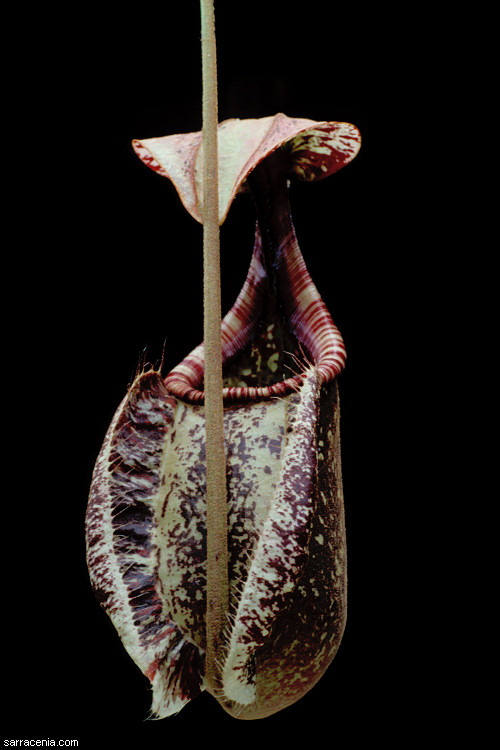
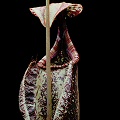 N. rafflesiana
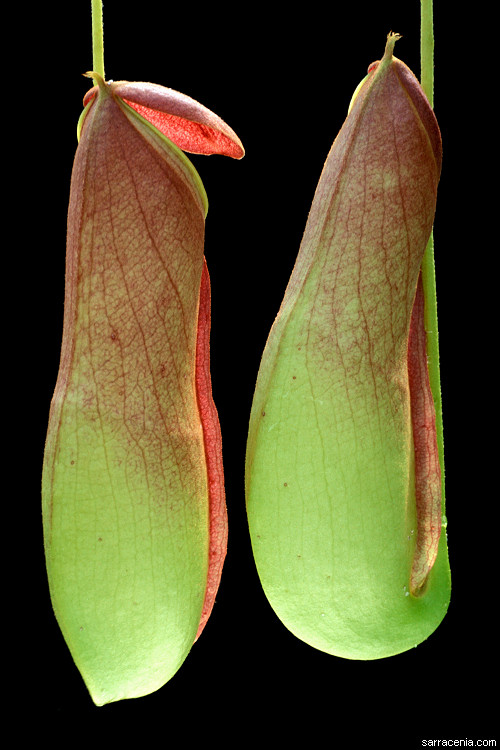
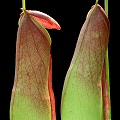 N. mirabilis
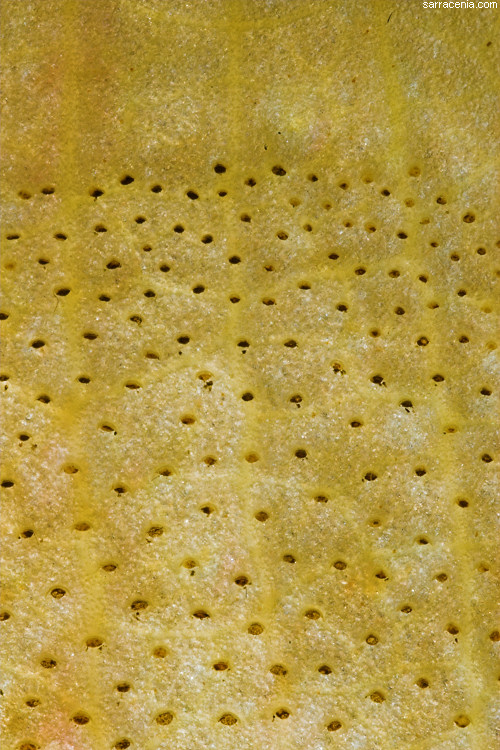
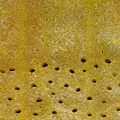 N. khasiana glands
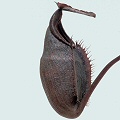 N. gymnamphora
 N. ampullaria
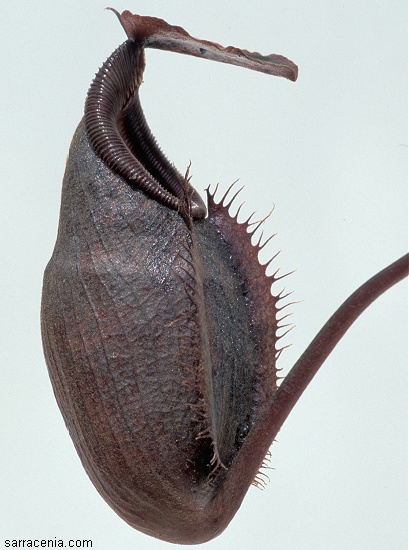
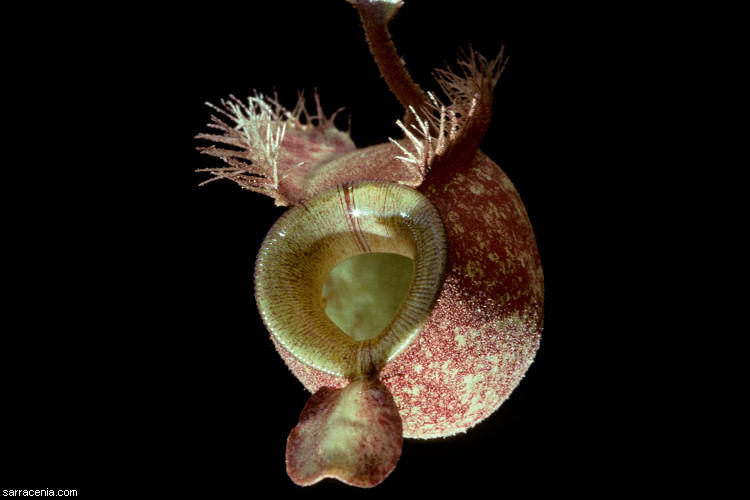
Nepenthes thorelii
Another poorly known species, relocated in the wild in 2011, for the first time
in 102 years (François Mey, pers. comm., 2011). Morphologically,
N. thorelii pitchers look somewhat like those of Nepenthes rafflesiana,
or at least a hybrid containing some of that species.
Nepenthes vieillardii
The most easterly of all the species, a pretty plant with red pitchers.
Page citations: Catalano, M. 2010, 2014, 2015, 2018; Cheek, M.R. 2015; Cheek, M.R., and Jebb, M.H.P. 2001;
Cheek, M.R. et al. 2018; Clarke, C., and Kruger, R. 2005, 2006;
Danser, B.H. 1928; Jebb, M.H.P., and Cheek, M. 1997; McPherson, S. 2009b, 2010; Mey, F.S. 2009; Nuanlaong, S. et al. 2016;
Rice, B. 2006a; Schlauer, J. 2002; Schmid-Hollinger, R. 1979; Wilson, G.W., & Venter, S. 2016.


