| New Guinean, Waigeo, and Sulawesian species | |
|---|---|
| Lowlanders | Highlanders |
|
N. danseri1 N. insignis2 N. tomoriana4 N. treubiana2 |
N. eymae4 N. glabrata4 N. hamata4 N. klossii2 N. lamii2 N. mariae4 N. minima4 N. monticola2 N. nigra4 N. paniculata2 N. pitopangii4 N. undulatifolia4 |
| Lowland-highland | |
|
N. ampullaria2,5 N. gracilis4,6 N. maxima2,4 N. mirabilis2,4,7 N. neoguineensis2 N. papuana2 N. tentaculata3,4 |
|
|
1Waigeo Island. 2New Guinea. 3Also in Borneo. 4Sulawesi. 5Also in Borneo, Maluku, Peninsular Malaysia, Singapore, Sumatra, Thailand. 6Also in Borneo, Peninsular Malaysia, Singapore, Sumatra, Thailand. 7Also in Borneo, Sumatra, Thailand, Philippines, Peninsular Malaysia, Maluku, Australia, Java, Indo-China, China, Hong Kong, Macau, Palau. |
|
Q: Nepenthes: species of Sulawesi, Waigeo, and New Guinea
A: We have discussed the major centers of Nepenthes biodiversity,
but there are a few minor areas of note still to mention.
Sulawesi (also known as Celebes) is a part of the country of Indonesia. It lies immediately east of Borneo, and
is about 175,000 km2 in area (about 24% as large as Borneo). Sulawesi is one of the four "Greater Sunda
Islands" (the other three are Borneo, Java, Sumatra), all of which are home to
Nepenthes.
New Guinea lies to the east of Sulawesi, and is directly north of Australia. It is 786,000 km2 in area, making it the
second largest island (smaller only than Greenland, although I think the whole island vs. continent thing is kind of arbitrary).
Politically it is divided into two roughly equal areas---the eastern portion is the independent country Papua New Guinea, while
the western portion is administered by Indonesia, and contains the provinces Papua and Papua Barat
(formerly known as Irian Jaya).
Waigeo is a small island northwest of Papua. It is administered by Indonesia.
Most of the species on this page have already been mentioned. However, if you strive to see every
Nepenthes species you will have to visit New Guinea to see its seven endemic species,
Sulawesi for its four endemic species, and Waigeo to see N. danseri. Oh, and you will have to visit
either New Guinea or Sulawesi for N. maxima. There are at least four other species in these
islands, but they occur in the previously described pages. Nepenthes tentaculata is pretty remarkable
in being a highland species that occurs in two widely separated places---both Sulawesi and Borneo. Most of the
Nepenthes with disjunct ranges are lowland or lowland-highland species.
Nepenthes danseri
A somewhat unremarkable, N. gracilis-like plant.
Nepenthes eymae
A plant that has the odd, funnel shaped pitchers of N. inermis
but the lid of N. fusca (at least for the upper pitchers--the lower pitchers are less
remarkable).
Nepenthes glabrata
This species has small pitchers that always have spots that are vertically elongated,
giving the pitchers an oddly stretched appearance.
Nepenthes hamata
One of the most frightening plants in the genus. The peristome of mature plants is
shaped like a large set of curving daggers. Very punk. Very scary. Other than the peristome, though, it looks just like
Nepenthes tentaculata.
Nepenthes insignis
An attractive plant with a large peristome and heavy lid.
Nepenthes klossii
A pitcher with a slightly humped back, similar to that of
N. aristolochioides but less pronounced.
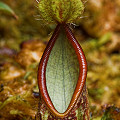 N. tentaculata
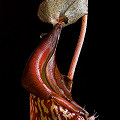 N. maxima
 N. hamata
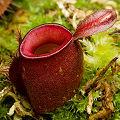 N. ampullaria
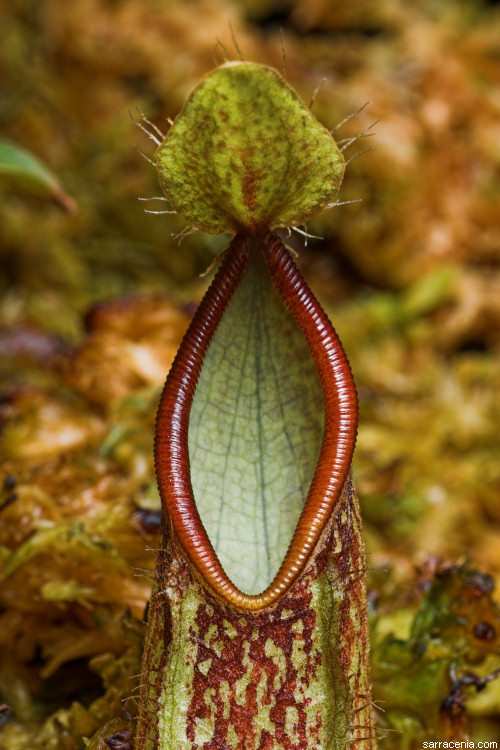
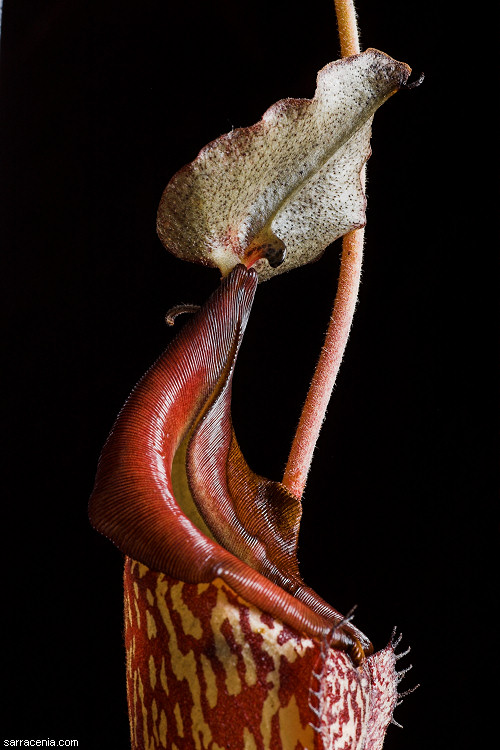
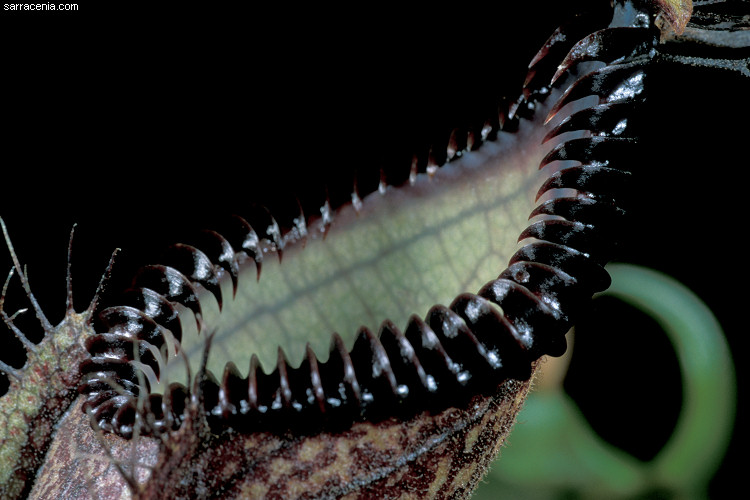
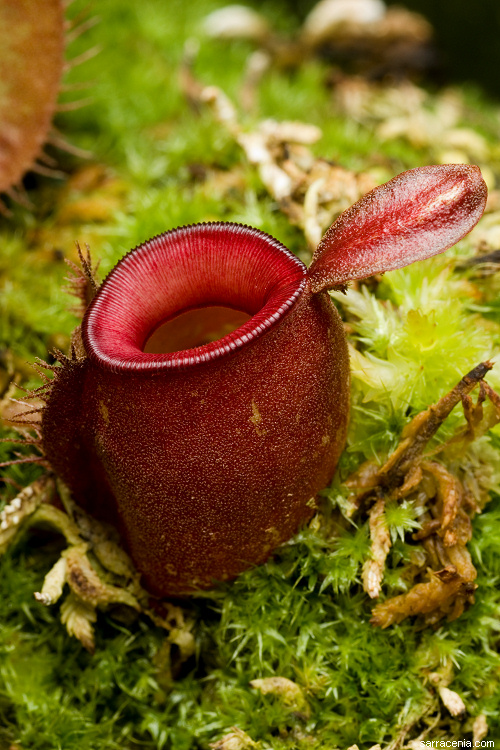
Nepenthes lamii
This species grows at an elevation exceeding 3000 m, higher than any other species in
the genus.
Nepenthes maxima
A really beautiful plant that is a classic staple for conservatory collections.
Many variant forms exist, some with spectacular coloration.
Nepenthes mariae
Originally published as Nepenthes maryae, but modified in deference to rules about
how Biblical names must be Latinized.
Nepenthes minima
This and Nepenthes abalata are the only known
species in the genus that are well-adapted for fire; for example with
a fleshy rootstock. To the eyes of some, this species is not sufficiently distinct from Nepenthes maxima.
Nepenthes neoguineensis
A fairly unremarkable plant.
Nepenthes nigra
Possibly conspecific with Nepenthes tentaculata.
Nepenthes paniculata
Another N. inermis-like plant, probably endemic to
Doormap Top in New Guinea.
Nepenthes papuana
A species from the southern part of New Guinea, from Fakfak to Balim Valley.
Nepenthes pitopangii
Known from but a single plant currently being observed in the wild. Hobbyists who have
discovered this plant have hacked it back on at least one occasion. Come on people, show some restraint! (I'm sure that if you spoke to
the people who did it, they'd pull the old...I'm doing it to protect the species song and dance...)
Nepenthes tomoriana
Named after Tomori Bay, most of the plants I have seen are unremarkable.
Nepenthes treubiana
Closely related to N. rafflesiana, it has similar
large pitcher wings. Found on Sorong and Misool Islands, on the western coast of New Guinea.
Page citations: Cheek, M. and Jebb, M.H.P. 2016a, 2016b; Danser, B.H. 1928; Jebb, M.H.P., and Cheek, M. 1997;
Lee et al. 2009, 2011; Nerz, J. et al. 2011; McPherson, S. 2009b;
Rice, B. 2006a; Robinson, A., et al. 2011; Schlauer, J. 2002.


