Q: Where do sundews (Drosera) live?
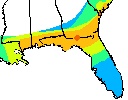 Southeast USA
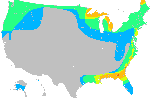 USA view
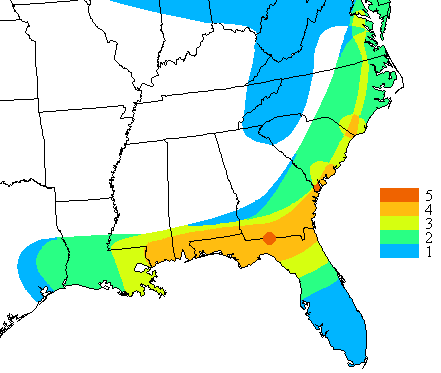
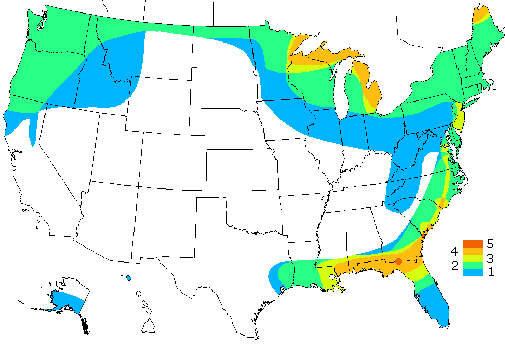
A: Here are some nitty gritty details about the ranges of
Drosera in North America. Start by looking at my generalized range
maps, to the right. They are useful, although they are based upon broad---and no doubt
inaccurate---generalizations. Habitat destruction also contributes to their inaccuracy. The main function is to give
you a general idea of areas that are more likely to have Drosera.
For completeness for US citizens, I included maps of Alaska and Hawai'i. The species in
Hawai'i is Drosera anglica, found in the Alaka'i swamp, on Kaua'i.
There are eight species in the USA and Canada:
D. brevifolia
D. capillaris
D. filiformis
D. intermedia
D. linearis
D. rotundifolia
D. tracyi
This is a straightforward list, and there are probaby only two reasons other botanists might disagree with it:
 D. linearis,
Montana D. intermedia,
Massachusetts
1) D. brevifolia Pursh, "D. leucantha Shinners",
and "D. annua Reed"
At one point in the past, the fine species D. brevifolia was shortly split
into two species, primarily
based upon flower color. This was short-lived, and the ephemeral names
"D. leucantha" and and "D. annua" are
no longer in use.
2) D. filiformis Raf. and D. tracyi Macf.
These two species have been, and still are, frequently treated as two varieties of the same species.
Accordingly, you may see them called Drosera filiformis
var. filiformis and Drosera filiformis var.
tracyi Diels, respectively. I used to follow this perspective, but now I believe that they are
best treated as two separate species (Rice 2011a.)
More detailed range information for each species is given below. It is
derived from Schlauer (1996) and Schnell (2002), but is supplemented by my own observations and searches of state
heritage databases.
I would appreciate hearing from regional biologists who might wish to correct my information!
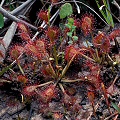 D. capillaris,
Mississippi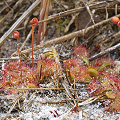 D. brevifolia
in North Carolina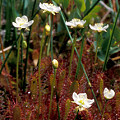 D. anglica flowering
in Idaho
Drosera anglica
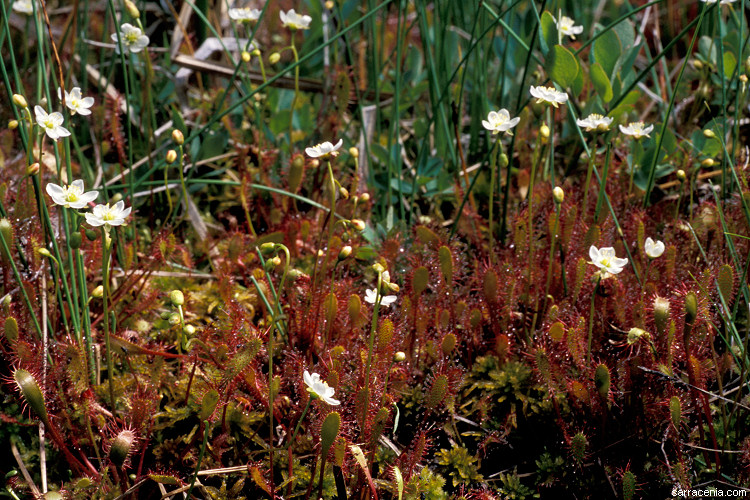
USA: Alaska, Washington, Oregon, California, Idaho, Montana, Wyoming, Colorado (1 site), North Dakota, Minnesota, Wisconsin, Michigan, Maine,
Hawai'i.
Canada: British Columbia, Alberta, Saskatchewan, Quebec, Newfoundland Island.
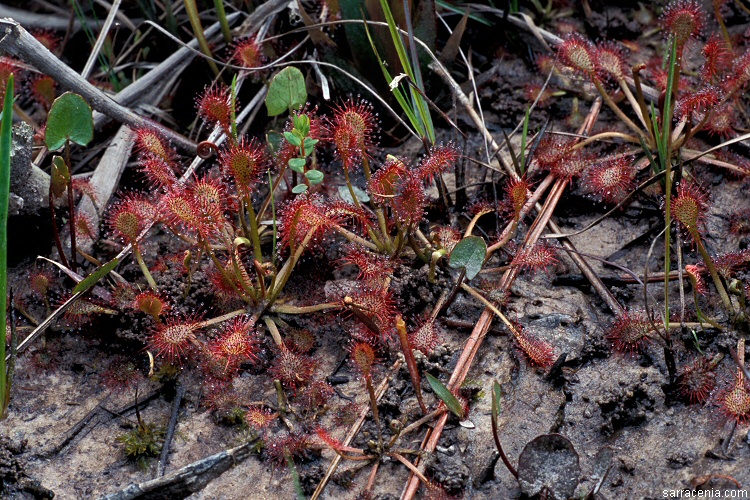
D. brevifolia
USA: Arkansas, southeastern Kansas, eastern Texas, Louisiana, Mississippi, Alabama, Florida, Georgia, Tennessee, South Carolina,
North Carolina, Virginia. Possibly Oklahoma, and Kentucky?
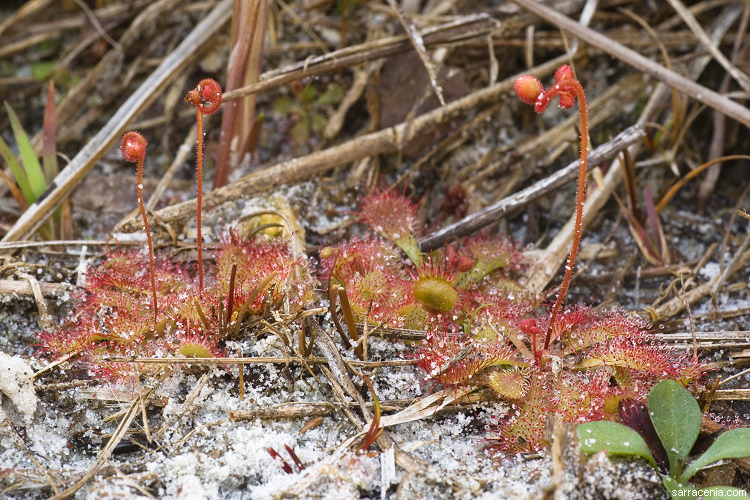
D. capillaris
USA: Texas, Louisiana, Mississippi, Alabama, Florida, Georgia, South Carolina, North Carolina, Virginia.
Possibly Tennessee? BONAP also cites MD, DE, AR, which I have not yet verified.
 D. intermedia,
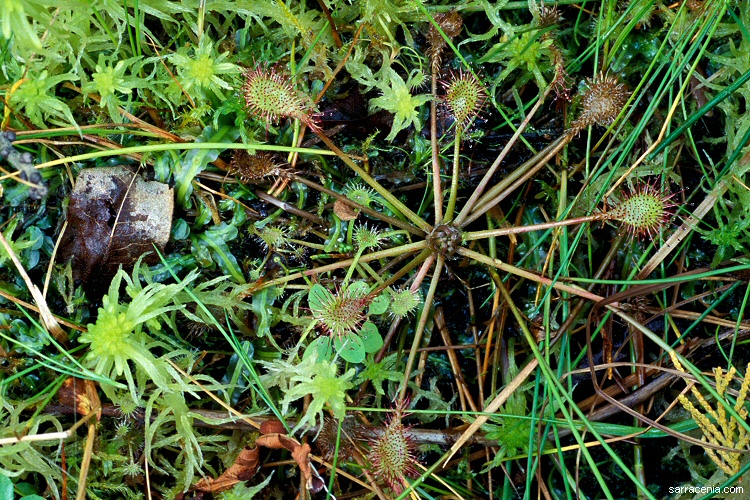
Massachusetts D. filiformis,
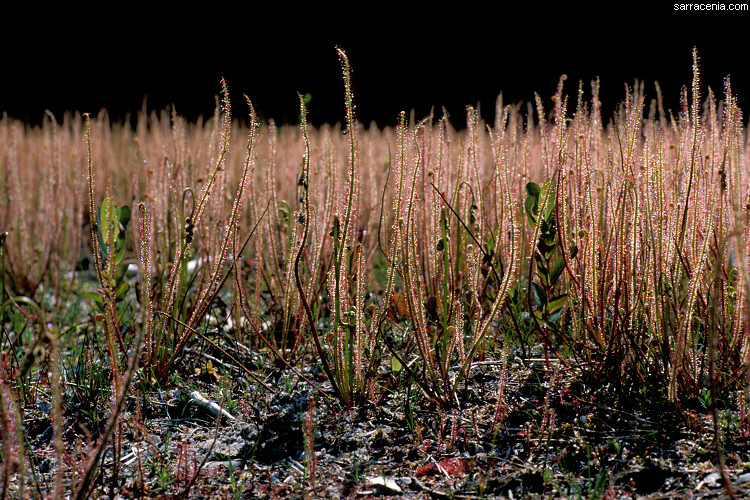
New Jersey D. filiformis,
North Carolina
D. filiformis
USA: Massachusetts (Plymouth, Barnstable, Nantucket, and Dukes Counties); Rhode Island (historical in Washington County,
now extinct there); Connecticut (historical in New London and Hartford Counties County, now probably extinct
there); New York (Suffolk County); New Jersey (Monmouth, Ocean, Burlington, Camden, Atlantic, and Cape May Counties);
Maryland (Charles County, and a non-native population has also been found in Prince Georges County); Delaware (probably
once in this state, but now extinct there); North Carolina (formerly in seven counties, now only in Brunswick and
Pender Counties), Florida (Washington and Bay Counties). Reports for South Carolina are not substantiated, while
collections from West Virginia and Pennsylvania are from non-native plantings.
Canada: Nova Scotia.
This species occurs in four general ranges. The three more northern populations comprise the plant known as
D. filiformis var. filiformis. Of these three range segments,
the northernmost is an isolated colony in Nova Scotia.
The second range, which includes the bulk of the species, is distributed from Massachusetts, southward to
Maryland. A third population occurs in
North Carolina.
In Florida there are
about twelve karst ponds with D. filiformis--I
have seen eight of the populations, and am confident they are not introduced. You can read about these
in more detail in my 2008 Florida trip report and my
2010 Florida trip report. Based on a variety of population differences, I published
the name D. filiformis var. floridana for these plants.
D. intermedia
USA: Minnesota, Wisconsin, Illinois, Kentucky, Tennessee, Mississippi, Louisiana, Texas, and all other states eastward,
up to Maine. Reports of this plant in Idaho or Montana are simply errors I have substantiated by field visits to the supposed sites.
Canada: Ontario, Quebec, New Brunswick, Nova Scotia, Prince Edward Island, Newfoundland Island.
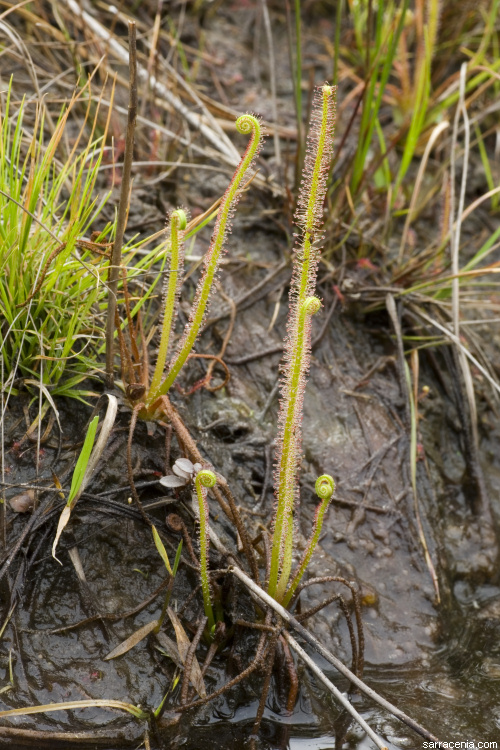
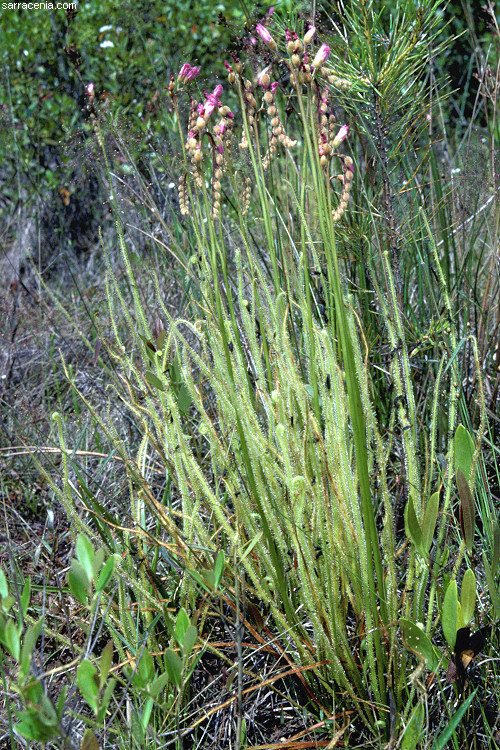
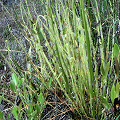 D. tracyi,
Florida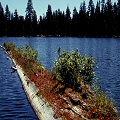 D. rotundifolia,
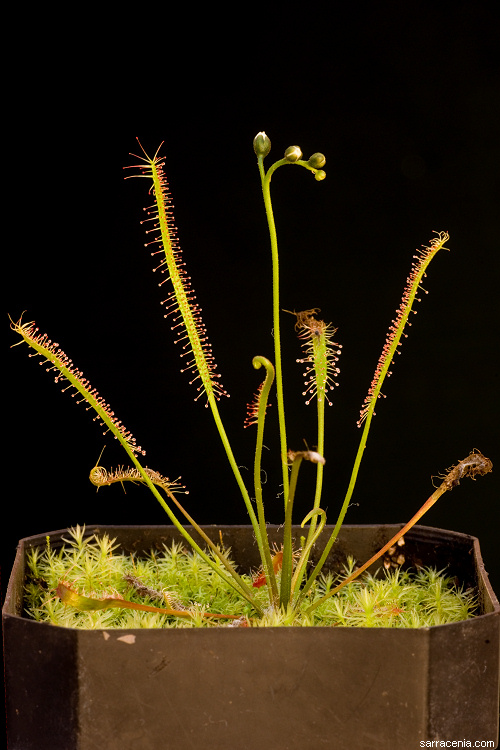
California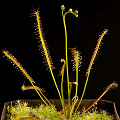 D. linearis flower,
in cultivation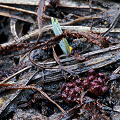 D. linearis,
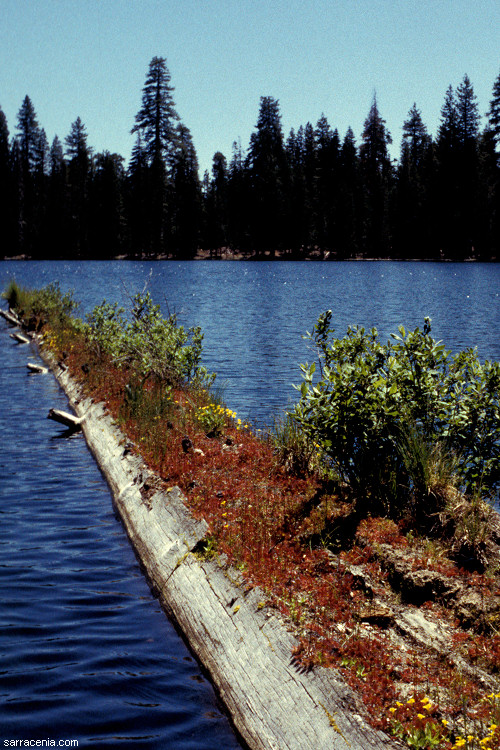
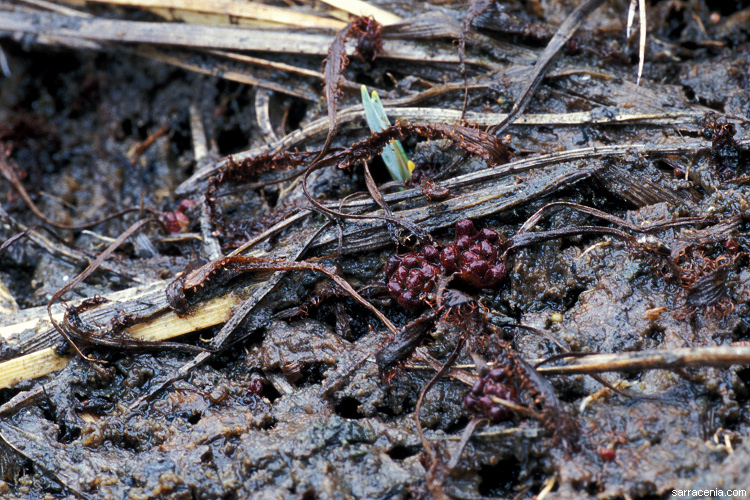
sleeping in Montana
D. linearis
USA: Montana, Minnesota, Wisconsin, Michigan, Maine.
Canada: Alberta, Ontario, Quebec, New Brunswick, Newfoundland Island.
D. rotundifolia
USA: Alaska, Washington, Oregon, California, Idaho, Montana, Colorado, North Dakota, Minnesota, Iowa, Illinois,
Kentucky, Tennessee, Mississippi, and all states eastward up to Maine, excepting Florida and George (possibly).
Canada: British Columbian, Alberta, Saskatchewan, Manitoba, Ontario, Quebec, New Brunswick, Nova Scotia, Prince Edward
Island,
Newfoundland and Labrador.
D. tracyi
USA: Florida (all counties west of, and including, Wakulla and Leon; but not Gadsen);
Georgia (formerly 8 counties, now only Colquit County); Alabama (5 southern counties); Mississippi (6 southern
counties); Louisiana (possibly historically from St. Tammany Parish, presumably extinct). Reports from South Carolina
have not been substantiated.
D. ×californica var. arenaria=
D. filiformis var. floridana × tracyi
USA: Florida (Washington County). I established this name to treat hybrids found in Florida. It irritates me to have to use
the epithet californica for a Florida endemic, but it turns out that there's no way around it
according to the rules of Latin nomenclature for naming species.
D. ×hybrida =
D. filiformis × intermedia
This plant has only ever been observed in New Jersey as a native.
D. ×obovata =
D. rotundifolia × anglica
USA: Oregon, California, the Great Lakes province, New England.
Canada: southeastern Canada.
D. anglica × linearis
USA: Michigan.
D. capillaris × intermedia
USA: North Carolina.
Page citations: D'Amato, P. 2001 (personal communication);
Kartesz, J. et al. 2009 (BONAP); Rice, B.A. 2006a, 2011a, 2017; Schlauer, J. 1996;
Schnell, D.E. 1976, 1999b, 2002a; Snyder, I. 2002 (personal communication); Wolf, et al. 2006;
personal observation.


