| More Latin American Pinguicula1 | |
|---|---|
| Caribbean species | South American species |
|
Subgen. Temnoceras sect. Temnoceras P. albida: Cuba P. benedicta: Cuba P. bissei: Cuba (P. caryophyllacea: Cuba) P. casabitoana: Dominican Republic P. cubensis: Cuba P. filifolia subsp. filifolia: Cuba P. filifolia subsp. alba: Cuba P. infundibuliformis: Cuba P. jackii: Cuba P. jaraguana: Cuba P. lignicola: Cuba (P. lippoldii: Cuba) (P. lithophytica: Cuba) (P. toldensis: Cuba) Subgen. Isoloba sect. Isoloba P. pumila: USA, Bahamas |
Subgen. Isoloba sect. Ampullipalatum P. antarctica: Argentina, Chile P. australandina: Argentina, Chile P. calyptrata: Colombia, Ecuador, Peru P. involuta: Bolivia, Peru P. jarmilae3: Bolivia P. nahuelbutensis: Chile Subgen. Temnoceras sect. Heterophylliformis P. elongata2: Colombia, Venezuela |
|
1All homophyllous unless otherwise noted. 2Heterophyllous. 3The name Pinguicula chuquisacensis also applies to this species. See my notes below. |
|
Q: More Latin American Pinguicula
A: Here we enter an area where we know surprisingly little about
Pinguicula. Many of these species are endemic to Cuba, and as such are difficult for
botanists to visit because of a raft of permits required. USA botanists are essentially prohibited from doing science in Cuba
because of USA laws that are truly bizarre and inconsistent with reality. In any event, many of these species
are highly localized in range, and are probably very endangered. They would be very interesting to learn more about.
Changes from 2016-2018
Subgenus Isoloba section Agnata was absorbed into
subgenus Temnoceras section Temnoceras. Furthermore,
several species were lost, as
P. caryophyllacea is absorbed into P. benedicta,
P. lippoldii and P. toldensis are absorbed into
P. bissei, and
P. lithophytica is absorbed into P. jaraguana.
Subgenus Isoloba section Isoloba as represented in this region is unchanged.
Subgenus Temnoceras section Ampullipalatum was moved to subgenus Isoloba
section Ampullipalatum, and it lost
P. elongata to its own section.
Subgenus Temnoceras section Heterophylliformis from Casper, which was not used by all botanists, is reformed with
P. elongata.
Pinguicula antarctica
Despite this plant's name, it does not occur in the continent of Antarctica. I really
shouldn't have to say this, but this plant's name has inspired at least one internet April Fool's joke, and has confused a
number of young acolytes just starting to study the genus. Although it may in fact be the carnivorous plant with the
most southerly range, it certainly does not grow on the continent of Antarctica.
Pinguicula australandina
The beast previously known as P. chilensis Clos was found to have some technical problems
with how it was named, so this name was established to replace it.
Evidence appears to be mounting that would result in a merger of this species with P. bissei.
Pinguicula benedicta
Evidence appears to be mounting that would result in a merger of this species with P. bissei.
Pinguicula elongata
A very striking plant with erect, elongate leaves. I wonder if it possibly captures
prey using a hybrid foraging strategy, similar to the pitfall-sticky trap method used by
Drosophyllum. Is it possible it uses its short, early-season leaves to make a bowl-shaped
chamber, almost like that of a pitcher plant?
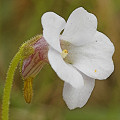 P. pumila
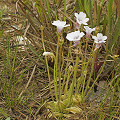 P. pumila
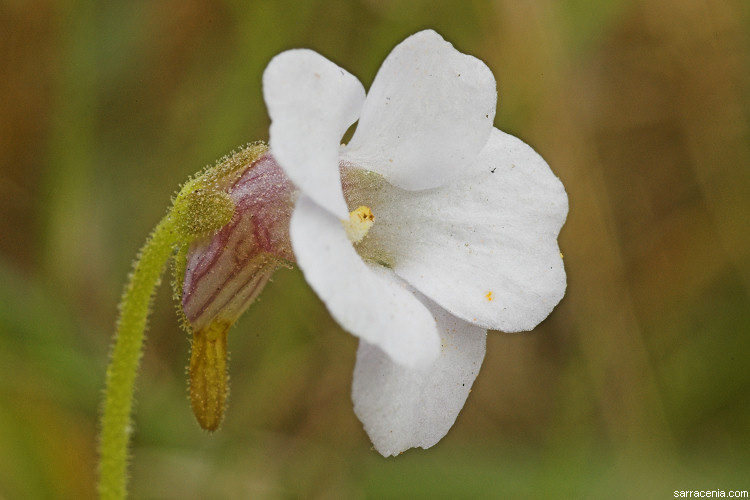
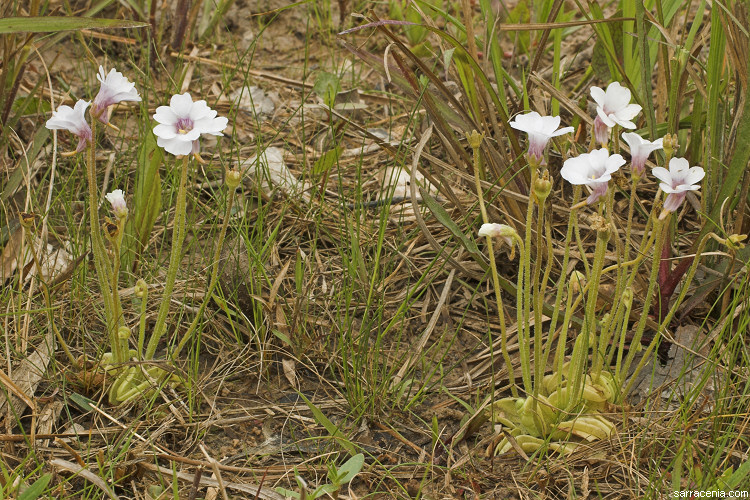
Pinguicula filifolia
A shortlived species that has long, delicate, threadlike leaves. I have been
unsuccessful at propagating this vegetatively or via selfing, which means that every time I have grown this, I enjoyed
it for about 2 years and then it died.
A white flowered variant (P. filifolia subsp.
alba Y. Domínguez, Panfet & V.Miranda) has been named.
somewhat surprisingly at the subspecific rank.
Pinguicula infundibuliformis
This species has not been seen since it was first discovered, in 1968, at two sites. Its distinctness, or affinities to other species, is highly uncertain.
Pinguicula involuta
This species is retained with a complete description of the plant, although Roccia et al. (2016) forgot to include this species
in their table of species counts, on page 65 of their work.
Pinguicula lignicola
A delicate Cuban species that, like P. casabitoana,
is a true epiphyte and lives on the vertical
surfaces of trees (including Pinus sp.) and shrubs.
Pinguicula jackii
This species is retained with a complete description of the plant, although Roccia et al. (2016) forgot to include this species
in their table of species counts, on page 65 of their work.
Pinguicula jarmilae
Reported from the Andes, with small flowers but relatively large leaves. The
species, along with Pinguicula involuta, produces stolons or runners.
The specimens used to describe this plant were actually illegally collected from the wild without permission, and the
description was published electronically. A few weeks later, "Pinguicula chuquisacensis"
was described in print, based upon legally collected material. However, the name P. jarmilae has
been accepted as having publication priority. Apparently, sometimes, it pays to break the rules. Hmm.
Pinguicula pumila
This is the only species mentioned on this page that strays out of the Caribbean or
South America. It occurs on mainland USA, all the way up to North Carolina.
Page citations: Beck, S.G. et al. 2008;
Casper, J. 1966, 1987, 2007; Gluch, O. 2017;
Halda, J.J. et al. 2007; Lampard, S. et al. 2016;
Panfet-Valdés & Temple 2008;
Rice, B. 2006a; Roccia, A. et al. 2016; Schlauer, J. 2002.


