Q: Heliamphora from the western ranges
| Western species | |
|---|---|
| H. arenicola | W of Ilu-Tramen Massif |
| H. ceracea | S (Brazilian) flanks of Pico da Neblina |
| H. hispida | S & C Neblina (Pico Phelps, Pico da Neblina) |
| H. macdonaldae1 | Southern Cerro Duida (and Cerro Huachamacari, Cerro Marahuaca?) |
| H. neblinae2 | NW & S Neblina, Cerro Aracamuni, Cerro Avispa |
| H. parva3 | NW & S Neblina |
| H. tatei4,5 | Cerro Huachamacari, Cerro Marahuaca, Cerro Duida |
|
1Some authors prefer H. tatei var. macdonaldae. 2What some authors mean by H. tatei var. neblinae. 3What some authors mean by H. neblinae var. parva or H. tatei var. neblinae f. parva. 4What some authors mean by H. tatei var. tatei. 5Probably includes H. tyleri Gleason. |
|
A: The western portion of the range occurs almost entirely (but not quite completely) in Venezuela.
I have not been to this part of the world, but all reports suggest that the area is difficult to travel through and survey.
It was long thought that Heliamphora in this western set of peaks were typically tall-pitchered, as compared to
the species far to the east. This rule has been found to be invalid.
Unfortunately, the most complete work on the genus (McPherson et al. 2011) has no botanical keys in it, so unless you know exactly
where your plant is from, you must work through the entire set of species, and picture-match your plant with the photos--since the book tends
to show noteworthy plants, even this is impractical.
Heliamphora arenicola
Distinguished from H. elongata by the smaller, helmet-shaped nectar spoon, and pitcher
coloration. Unlike H. nutans, it does not have a glabrous inflorescence.
Heliamphora ceracea
Unlike other species from its range, this does not have hairs on the internal pitcher
surface. The nectar spoon is also narrow, flat, and pointed--again unlike other nearby species.
Heliamphora hispida
A very shapely species with pitchers that are either green and red, or completely red.
Pitchers are only 15-25 cm tall (6-10 inches), and represent an example of a stout species in the western range. This plant may
be producing hybrid swarms with H. tatei
that are confounding taxonomists. This is a difficult problem for those who wish to be able to definitively identify each and every
plant!
Heliamphora macdonaldae
The upper inside of the pitcher of this species
glabrous and is beautifully colored on the interior pitcher
surface.
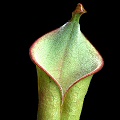 H. tatei seedling
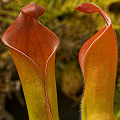 H. tatei youngster
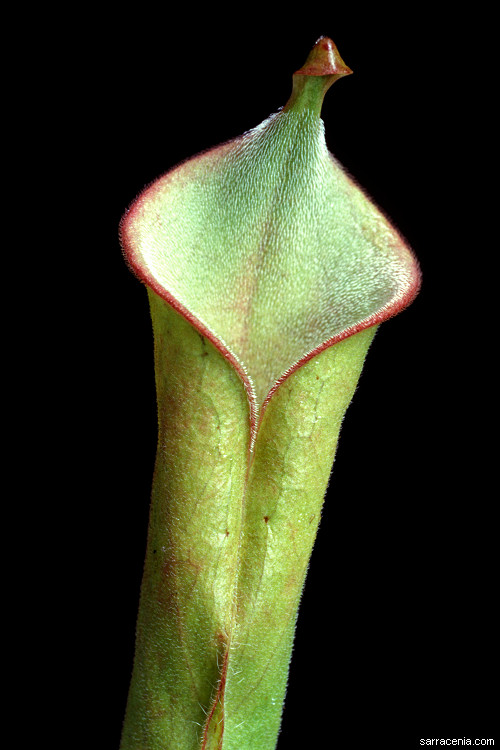
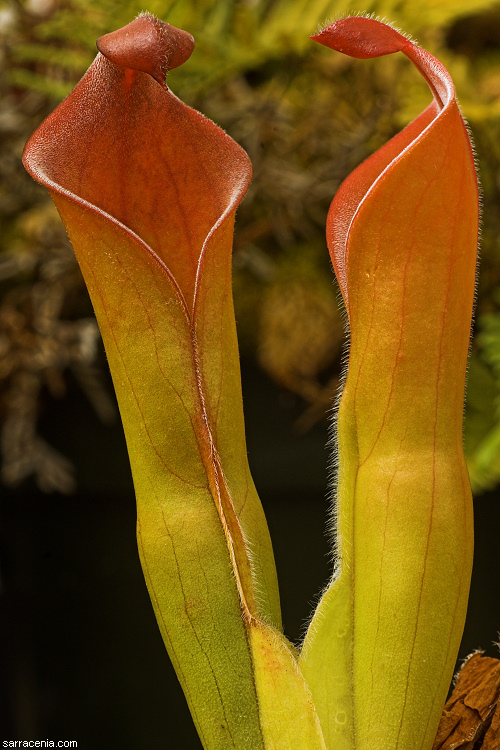
Heliamphora neblinae
This is a source of great controversy: is it a separate species or just a subspecies
of H. tatei? Many
H. neblinae in cultivation are actually H. tatei. Taxa such as
H. neblinae var. viridis Maguire and
H. neblinae var. parva Maguire are perhaps not merited, and may
have resulted in part from the confusion between H. neblinae and H. tatei.
Heliamphora neblinae occurs
in large highland meadows with Brocchinia reducta, and has a variable nectar spoon structure.
Heliamphora parva
an atypically small species, usually with a creeping stem--features the authors claim are
reasonably distinctive.
Heliamphora tatei
A giant that can make scrambling stems 1.5 meters tall (5 feet)! The green or greenish-red pitchers
pitchers are also large---they are up to 50 cm tall (20 inches) tall with
slightly swollen bellies and pitcher tubes that gently expand upwards. The nectar spoon is flat or conical, and narrow at the base.
The populations in Cerro Aracamuni by Cerro Avispa are somewhat different in character.
This is the second species of Heliamphora
ever to be discovered, in 1928.
Hybrids have been found from the area involving H. arenicola, H. ceracea, H. hispida, H. neblinae,
and H. parva.
Page citations: Berry, P., et al. 2005; Givnish, T.J. et al. 2000;
McPherson, S. 2006; McPherson, S. et al. 2011;
Nerz, J. and Wistuba, A. 2000; Rice, B. 2006a; Schlauer, J. 2002.


