Q: Any other Drosera species
| Left over Drosera | |
|---|---|
|
D. adelae1,8 D. arcturi2,8,9 D. binata var. binata3,8,9,10 D. binata var. dichotoma3,8,9,10 D. burmannii4,8,11 D. glanduligera5,8 D. hamiltonii6,8 D. murfetii2,8 D. neocaledonica6,12 |
D. oblanceolata6,13 D. prolifera1,8 D. schizandra1,8 D. spatulata var. spatulata6,8,9,11 D. spatulata var. bakoensis6,14 D. spatulata var. gympiensis6,8 D. stenopetala7,9 D. tokaiensis6,15 D. ultramafica6,16 |
|
1section Prolifera. 2section Arcturia. 3section Phycopsis. 4section Thelocalyx. 5section Coelophylla. 6section Drosera. 7section Psychophila. 8Australia. 9New Zealand. |
10Chatham Islands. 11Southeast and mainland Asia. 12New Caledonia. 13China, Hong Kong. 14Borneo. 15Japan. 16Indonesia (Sulawesi), Malaysia (Sabah); Philippines (Palawan), Sumatra. |
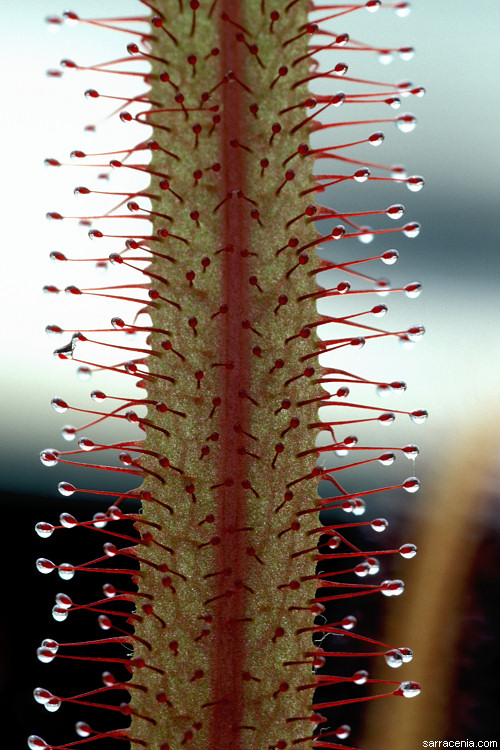
D. adelae
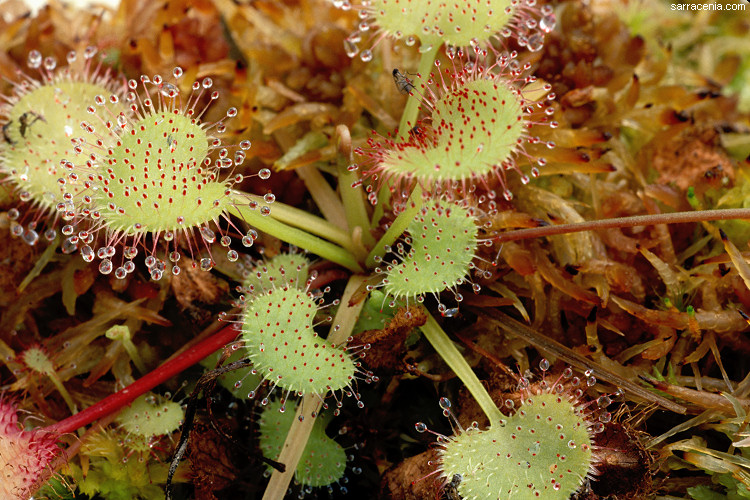
D. prolifera
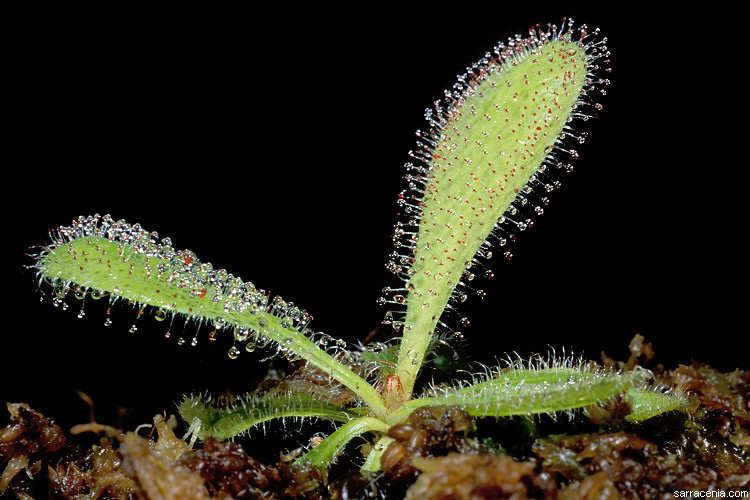
D. schizandra
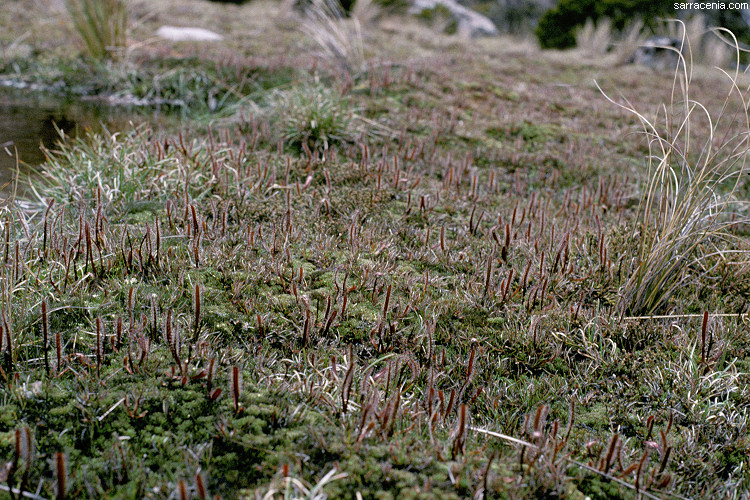
D. arcturi
A: The species that do not fit into my previous FAQ pages are all listed here. And what a mixed
bag they are! Some comments on them follow.
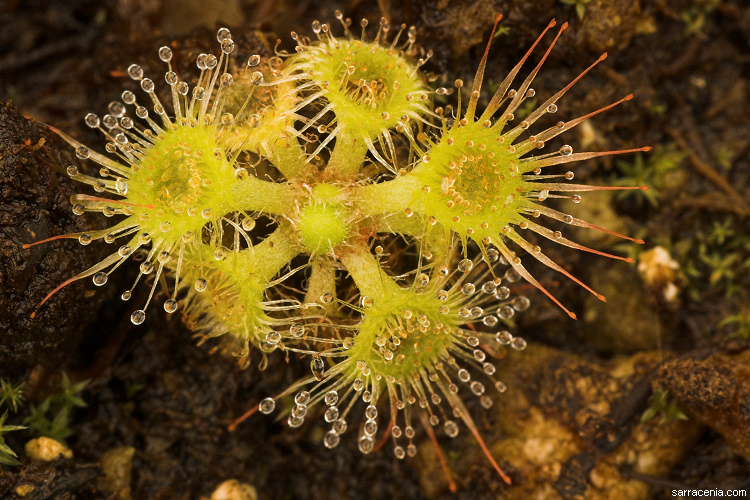
Drosera adelae
One of three plants frequently called a
"Queensland sundew". This is the easiest of the three to grow in a terrarium.
Drosera arcturi
A very hard to grow temperate species that enters dormancy during the winter.
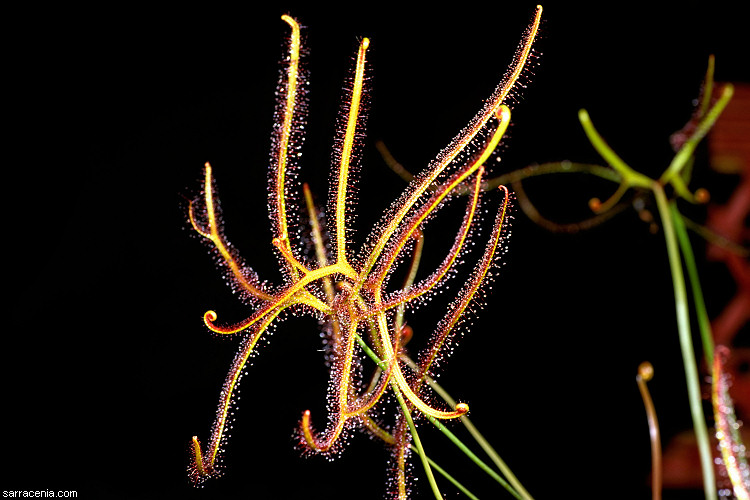
Drosera binata
The great fork-leafed sundew. So far, only one variety of this plant has been validly
named, while horticulturists have a lot of other names in illegal use. Specifically:
"T-form:"--really simply the typical form, and in cultivation (at least in the USA) usually denotes
plants with mostly one bifurcation and deep green foliage that becomes red-tinged with age.
"Multifida"--an undescribed form with foliage coloration similar to
the "T-form", but with approximately 8-16 leaf tips.
"Extrema"--as above, but with 16-40+ leaf tips.
Drosera binata var. dichotoma
This name indicates plants with yellow-green foliage
that regularly divides into four (or occasionally a few more) branches. Horticulturists have a selection of this called
Drosera binata 'Giant'.
A noteworthy Drosera binata cultivar is Drosera 'Marston Dragon'.
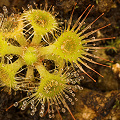 D. glanduligera
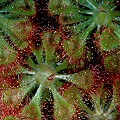 D. burmannii
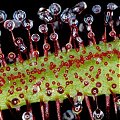 D. binata
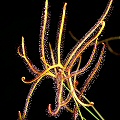 'Marston Dragon'
Drosera burmannii
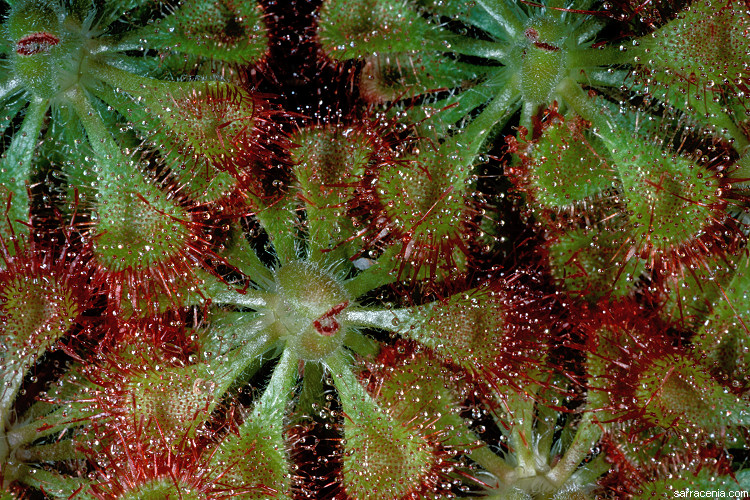
Known for its extremely
fast tentacle action, the marginal tentacles of D. burmannii can move 180° in a matter of tens
of seconds or even less, transporting or pushing bewildered insects into the middle of the leaf.
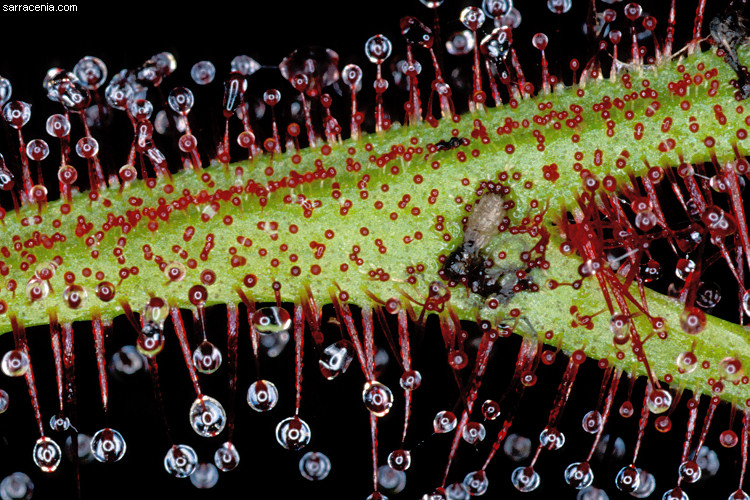
Drosera glanduligera
The absurdly fast tentacle action of this species results in a snap action
so rapid as to nearly catapult prey into the middle of the trap! Siggi Hartmeyer calls these this kind of sundew a snap-trap.
Drosera hamiltonii
A very nice species with flat leaves that unroll like a carpet. This species
is easy to maintain, but a little tricky to grow well. It flowers gorgeously, but only if provided with a chilly winter.
It is easily propagated by root cuttings.
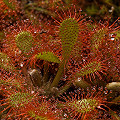 D. ×nagamotoi
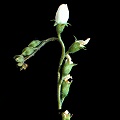 D. spatulata
 D. hartmeyerorum
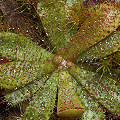 D. hamiltonii
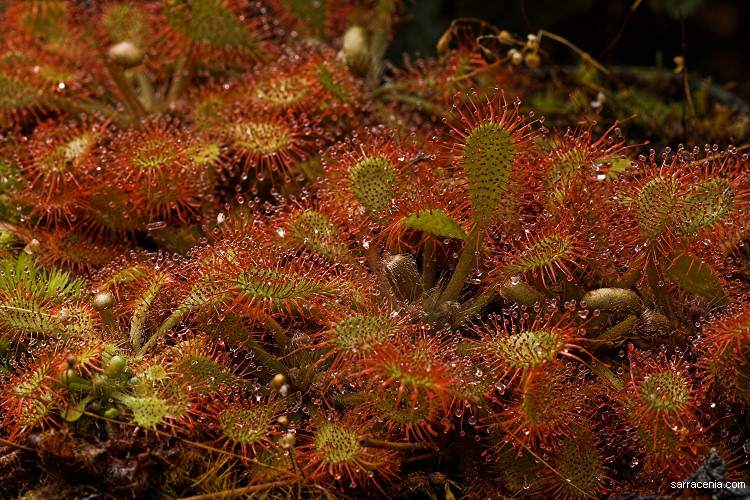
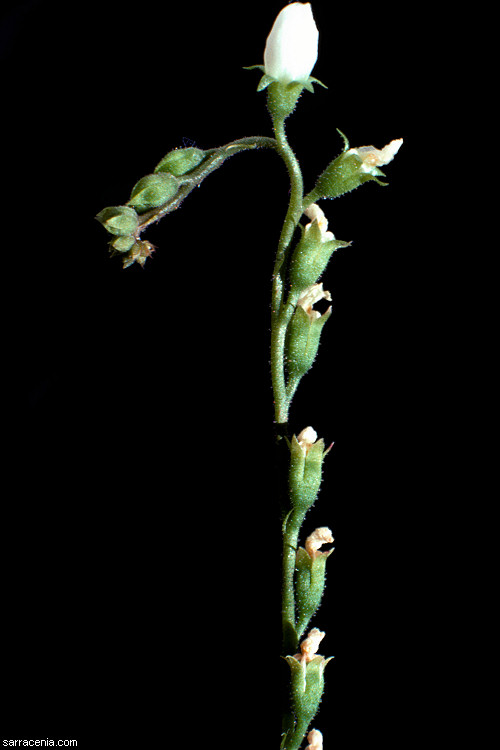
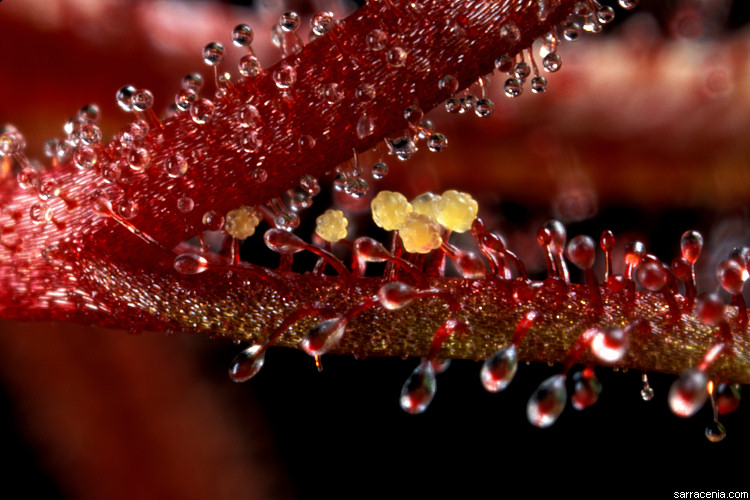
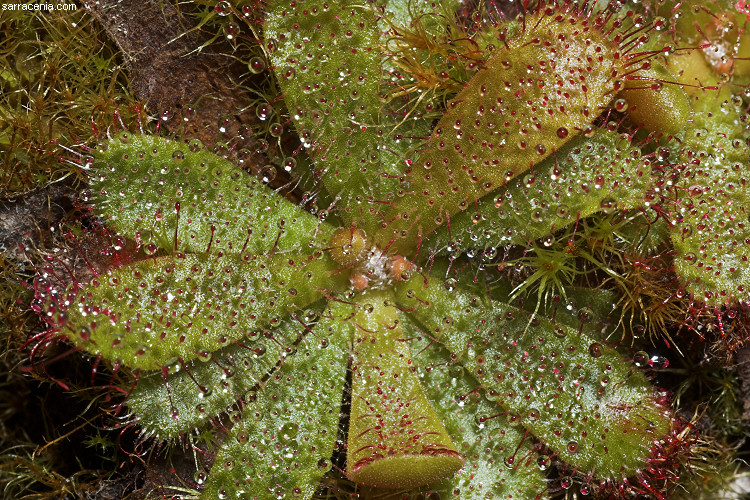
Drosera murfetii
Closely related to D. arcturi. It is distinct by its overall
larger size, bigger flowers, and that it only produces one or two carnivorous leaves per season (the other leaves are short and scale-like).
Older references (such as my own!) to a robust Drosera arcturi from Tasmania is this species.
Drosera prolifera
One of the three
"Queensland sundews". A little tricky to cultivate, it is is particularly cool in producing plantlets on
its flower stalks, much like a strawberry plant.
Drosera schizandra
The hardest of the three "Queensland sundews" to grow.
Drosera spatulata
A widely occurring species with many variant colors and sizes, many of which are
quite lovely. It is likely that in time, yet more of these will be split into separate species. The plant noted on many growers'
inventories as "var. lovellae" is a name that has never been established but should be, if only
as a cultivar. The Japanese Drosera 'Kanto', the very dark red
Drosera 'Ruby Slippers', and the large Drosera 'Tamlin'
are all cultivars of Drosera spatulata.
Drosera stenopetala
Another tricky, temperate species.
Drosera tokaiensis
A species of hybrid origin, that is
D. rotundifolia × D. spatulata. This hybrid is sterile,
and has been designated Drosera tokaiensis nothosubsp. hyugaensis. That
hybrid is sterile, but in the wild, by natural chromosome doubling, the sterile hybrid became fertile, and thus this
species emerged. Over time, it has established itself as a natural, coherent entity that is appropriately considered a
species. This is quite analogous to the emergence of Drosera anglica.
It is also referred to by the
horticultural cultivar name, Drosera 'Kansai', or sometimes with a symbol indicating its
hybrid parentage, i.e. Drosera ×tokaiensis. This is similar to another entity of
hybrid origin, Drosera ×nagamotoi. In this latter case, the entity is entirely of
horticultural origin, i.e.
Drosera ×nagamotoi=D. anglica × spatulata.
Drosera ultramafica
The only species that is endemic to Southeast Asia. It appears to be
strongly associated with serpentinite soils. Distinct from D. spatulata by a number of
characteristics, including a stem forming
habit.
Page citations: Fleischmann, A. & Lee, C.C. 2009;
Fleischmann, A. et al. 2011; Lowrie, A. 1999, 2013; Lowrie, A., and Conran, J.G. 2014;
Lowrie, A. et al. 2017a, 2017b; Rice, B.A. 2006a; Robinson, A. et al. 2017;
Salmon, B. 2001; Schlauer, J. 1996, 2002;


