Q: North American Drosera
| Species of Canada & USA1 |
|---|
|
D. anglica3 D. brevifolia4 D. capillaris4 D. filiformis var. filiformis2,5 D. filiformis var. floridana2,5 D. intermedia6 D. linearis2 D. rotundifolia3 D. tracyi5 |
|
1All in Drosera sect. Drosera. 2Endemic to Canada and the USA. 3Also grows in temperate Asia and Europe. 4Ranges south to South America. 5Part of the "D. filiformis complex". 6Ranges into Europe and South America. |
A: Although the USA and Canada is not home to a particularly large number
of Drosera species, so many FAQ readers are from this region (including your humble FAQ-writer)
that it makes sense to use a separate FAQ page to comment on these plants.
These are (almost) all rosetted species with leaves that
have glandular blades that range from short to very long and threadlike. If you have a plant that is hard to identify
by the leaves, you will be happy to know that you can reliably identify most by seed shape and coat characters.
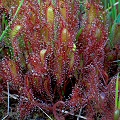 Medium leaves
in California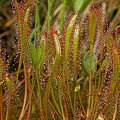 Long leaves
in California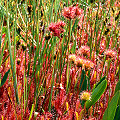 False vivipary
in Oregon
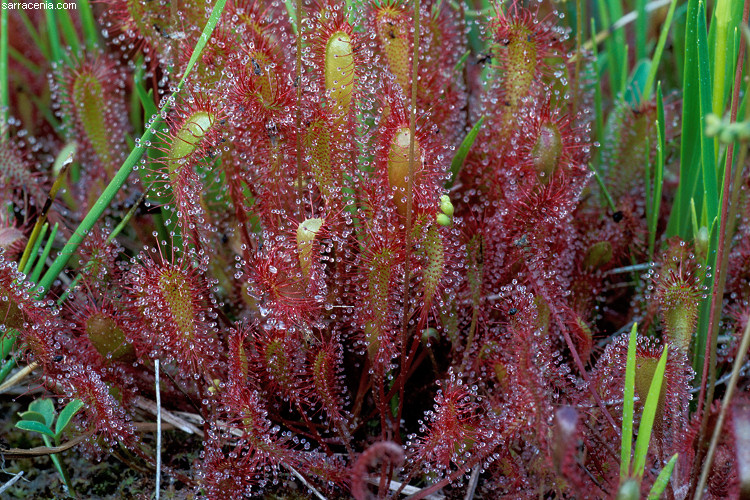
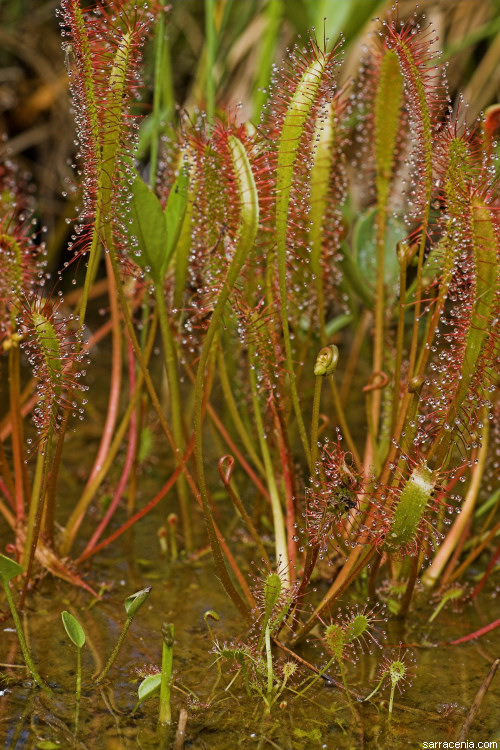
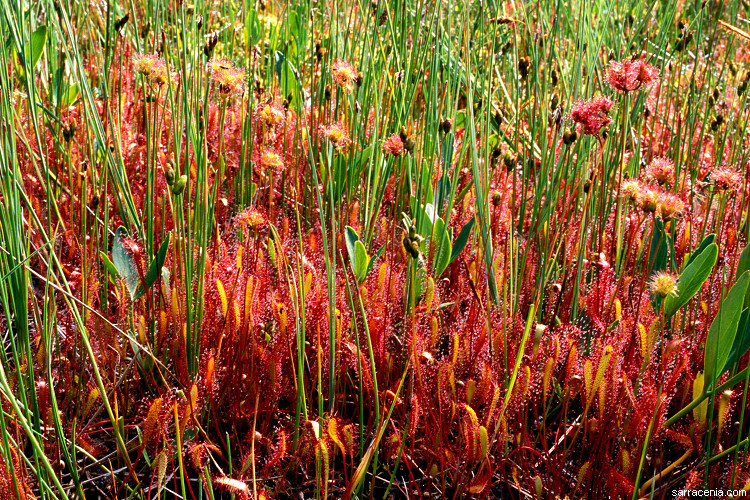
Cultivation is easy for most species. Grow them in a peat:sand mix, kept moist year-round, and in full sun.
They are not picky about temperatures, but
should not be exposed to frost during the growing season. I recommend you refer to weather data web sites (such as weather.com) and
learn about the summer temperatures your plants
would expect, based upon their native ranges. During the winter, all the species (except
D. brevifolia and D. capillaris) produce
winter resting buds to survive the chilly winter. These buds are called hibernacula.
Hibernaculum-forming species should be given a dormancy
as I describe in other FAQ pages; see the general cultivation guidelines and the relevant Dionaea
pages. During the winter, do not expose your plants to temperatures below freezing unless you really know what you
are doing, or are experimenting on spare plants.
Below I have some comments about each species. I have global range information, derived from Schlauer (1996) and
Schnell (2002). For details on ranges within North America, look here.
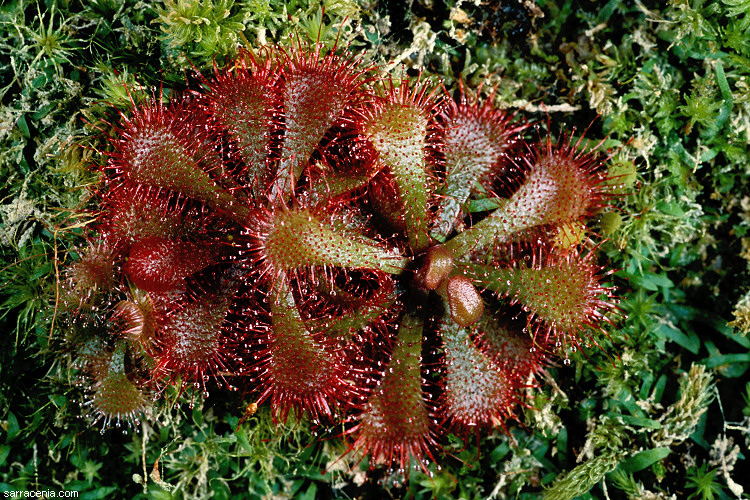
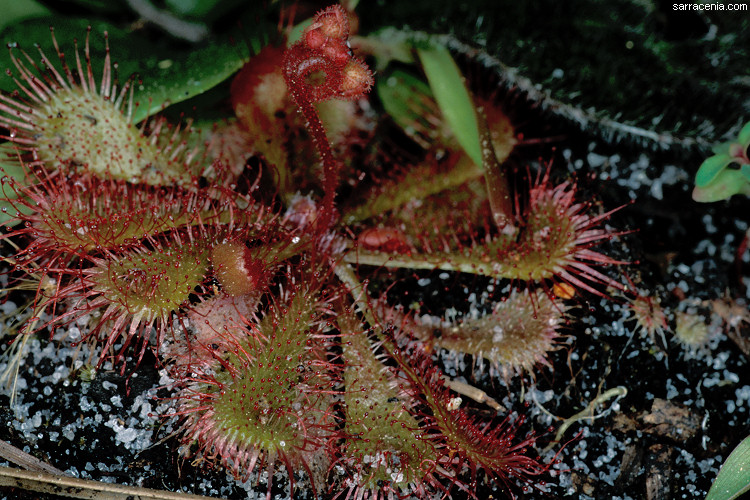
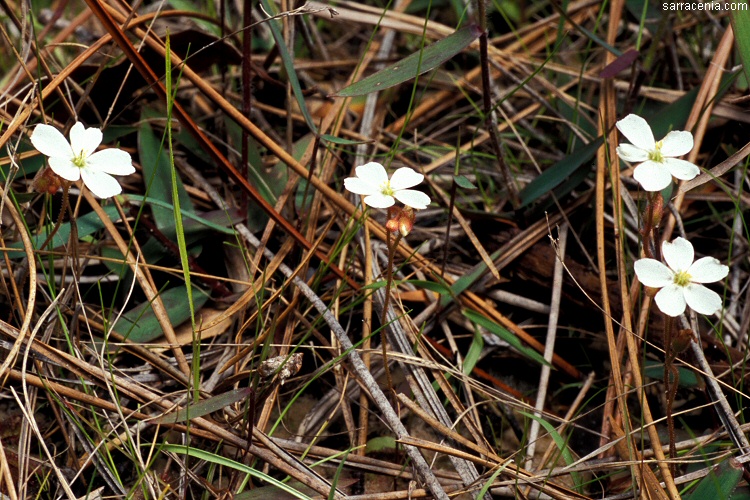
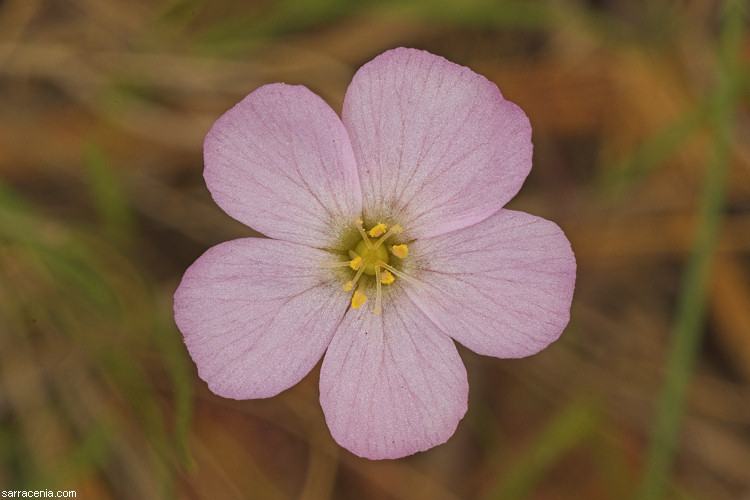
 D. brevifolia
in cultivation D. brevifolia
in Florida D. brevifolia
in Mississippi D. brevifolia
in Texas
Drosera anglica
Drosera anglica is a beautiful plant with glandular leaf blades that are much longer than they are wide.
The leaf blades of some plants are just a few times longer than they are wide, but the leaves of some strains are really long.
Plants I have seen in parts of California, and herbarium sheets I have seen from Thunder Bay (Canada) are really long, so much so that
the plants almost look like D. capensis!
Drosera anglica is notable for occurring in Alaka'i Swamp, on Hawai'i.
Although fertile, Drosera anglica is thought to be of ancient hybrid origin, that is
D. rotundifolia×linearis. See more in the section on
Drosera × woodii, below.
 D. capillaris(?)
coastal Mississippi D. capillaris(?)
coastal Mississippi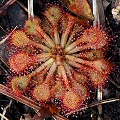 D. capillaris,
coastal Mississippi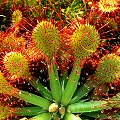 D. capillaris,
central Alabama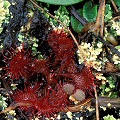 D. capillaris,
W North Carolina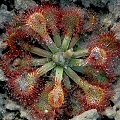 D. capillaris,
E North Carolina
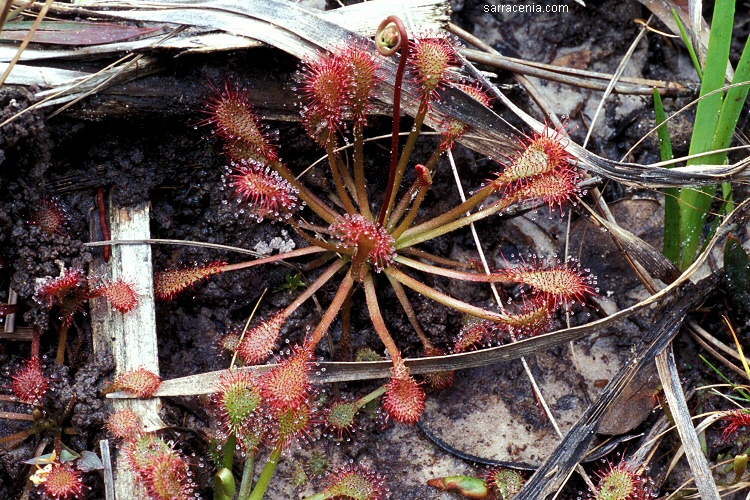
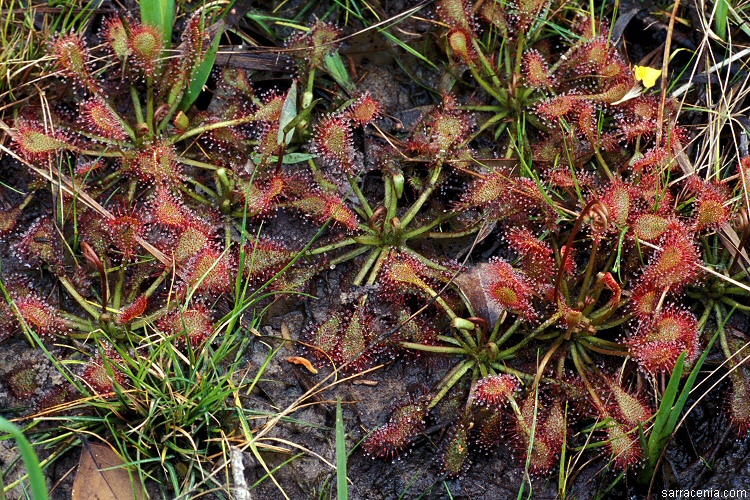
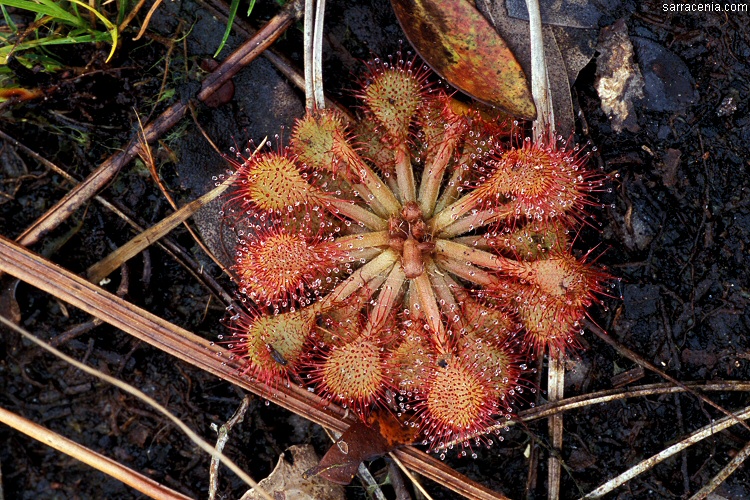
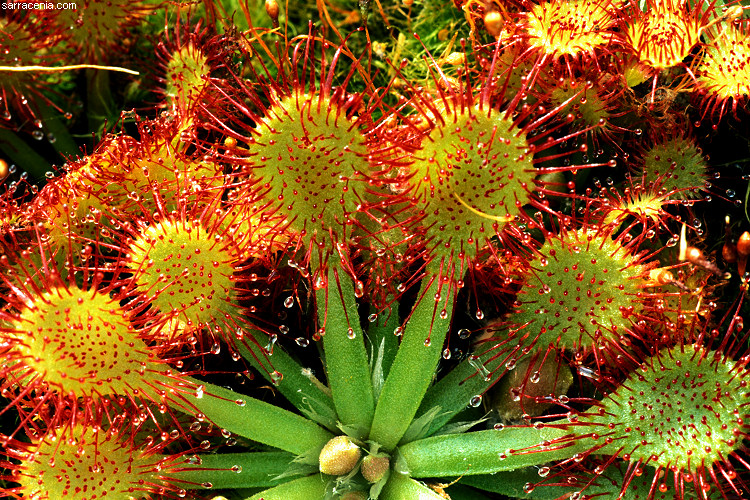
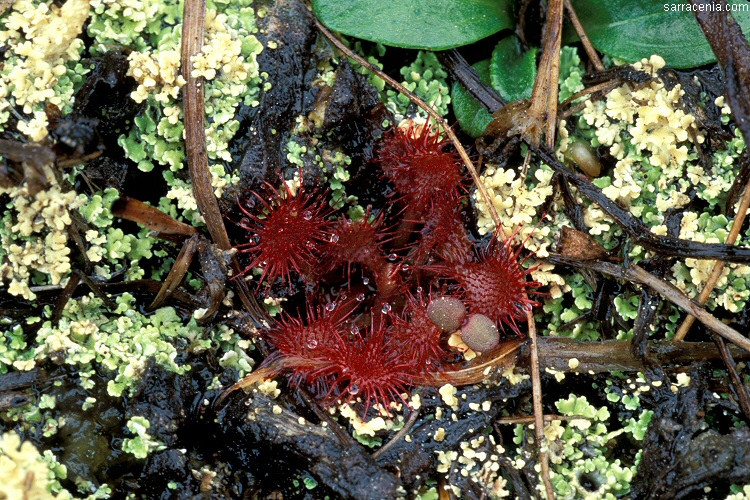
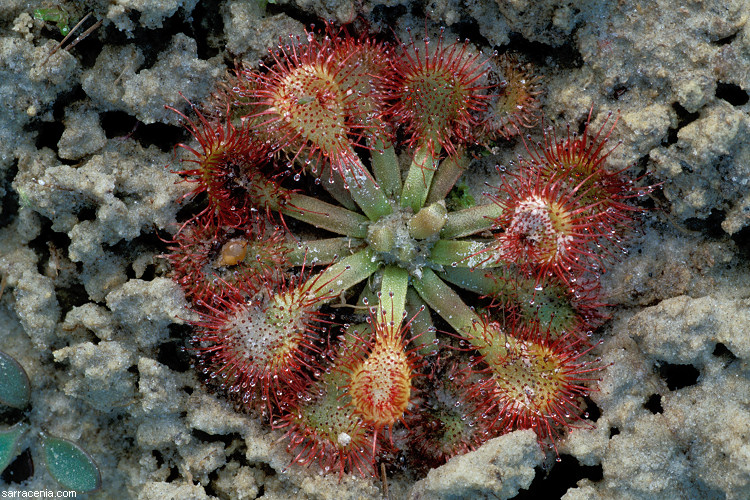
Drosera brevifolia
This is a cute litte plant that can be identified by its
wedge-shaped leaves. Another way to identify it in the field is by the the flower scape, which is
densely glandular. Two separate species have been described within this species,
D. annua for the pink-flowered form found in the Gulf Coast and inland sites, and
D. leucantha for the plant found along the Atlantic Coast. Subsequent studies have in
general thrown these separate species into sullen disrepute, although you occasionally see the names pop up here and there.
Just cross them out, and write "D. brevifolia" in its place.
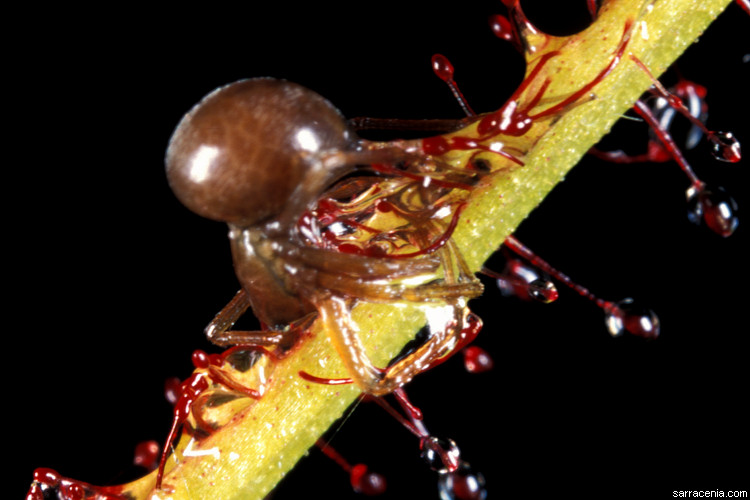
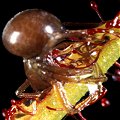 Eating a spider
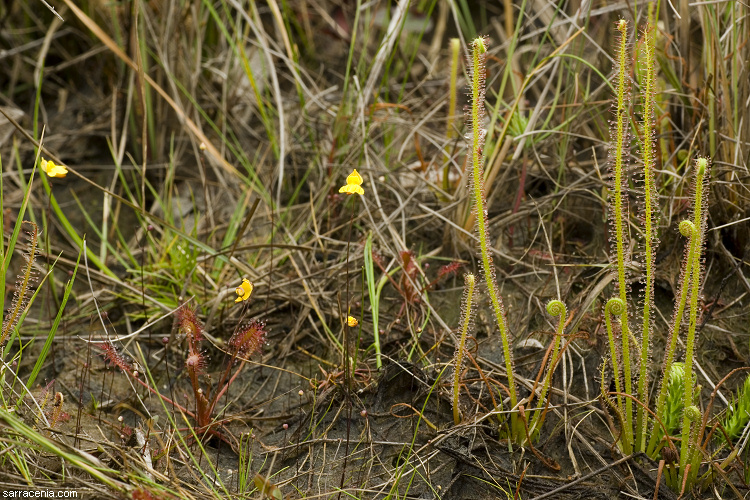
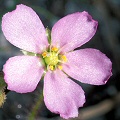 D. filiformis,
New Jersey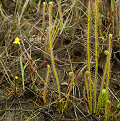 D. filiformis,
North Carolina
Drosera capillaris
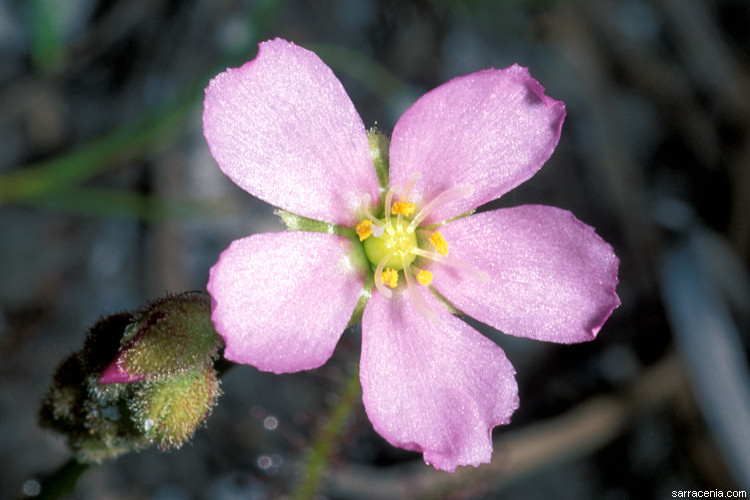
This is the typical sundew you are likely to encounter in the southeastern USA. Most of them are pink-flowered, but the occasional
white-flowered plant is reported. Jim Fowler tells me that in the Green Swamp, in North Carolina, the typical flower
color is white.
Finally, something weird is going on with the populations of D. intermedia
and D. capillaris, especially in the Gulf Coast and down into peninsular Florida.
In these areas you encounter bizarre " long-leafed D. capillaris" which look
completely unlike the D. capillaris you might see further inland. Many people speculate
we are seeing hybrid swarms, polyploids or something else similar. I am starting to adopt the heretic possibility that there
are some crytic species that have not been properly identified, but I have not spent enough field time to make
any kind of final pronouncement. I have some ruminations on this in my
2005 Mississippi/Louisiana field trip report.
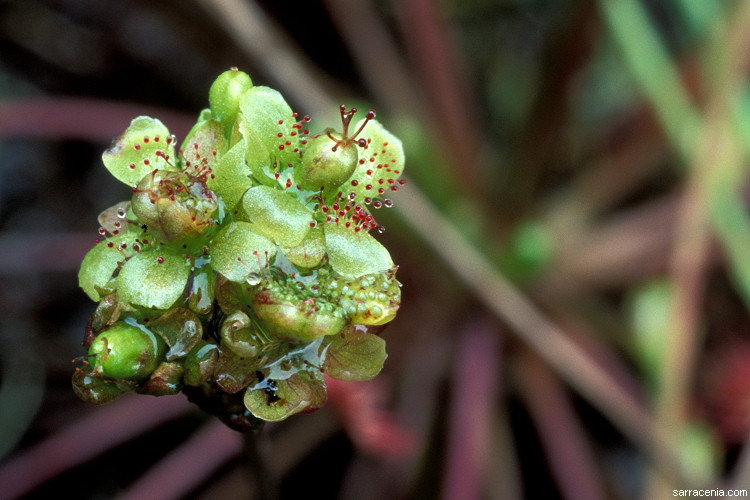
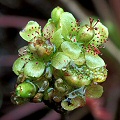 D. intermedia,
false vivipary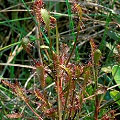 D. intermedia,
New Jersey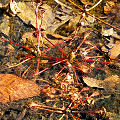 D. intermedia,
Vermont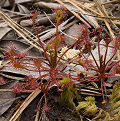 D. intermedia,
E North Carolina D. intermedia,
W North Carolina
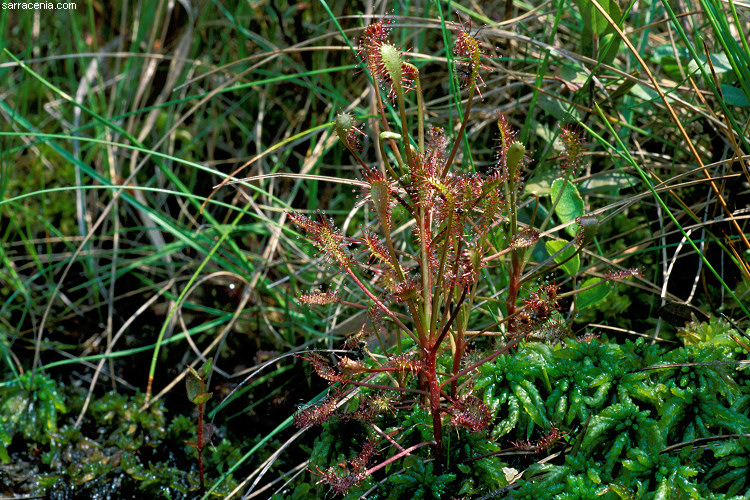
Drosera filiformis
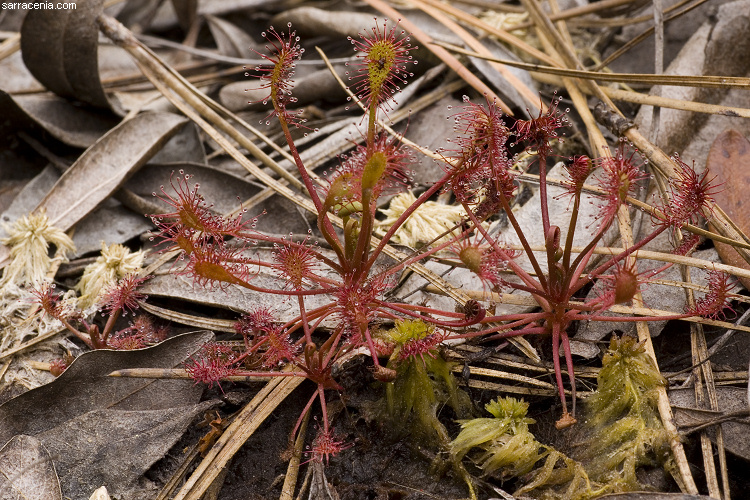
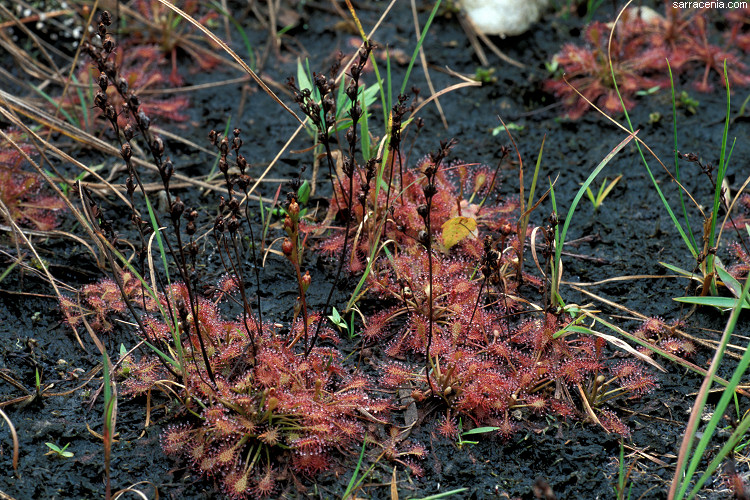
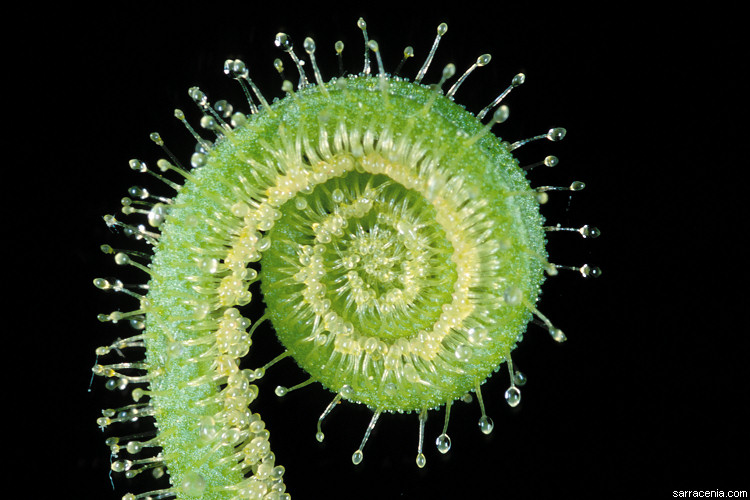
Drosera filiformis is instantly recognizable. Its long, glistening leaves unfurling like fern-fronds are
absolutely beautiful, especially when backlit at sunrise or sunset. This species occurs in
four separate range segments. The first three are centered approximately in Nova Scotia, New Jersey, and North Carolina--these
plants correspond to D. filiformis var. filiformis. A fourth range
segment occurs in Florida, and those plants are called D. filiformis var. floridana.
See also my comments on D. tracyi, below.
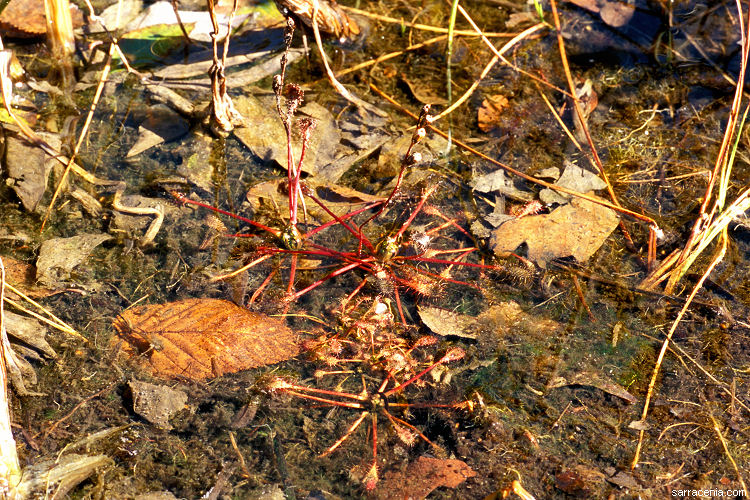
Drosera intermedia
This species has long narrow pedicels that point in the air at all angles, making a sort of hemisphere of death. This basic form
is useful to keep in mind when trying to identify plants in the field. (Stipule form is also helpful in separating this from
D. capillaris.) Another useful character is how the inflorescence does not emerge straight up from
the center of the rosette---instead it emerges hortizontally, then arcs upwards.
This plant has a wide geographic range, so it should be no surprise that it has many variant forms. In some regions, D. intermedia is a
ground-hugging rosette that looks very similar to
D. capillaris. Other areas the petioles are exceedlingly long. I think that one of the most
interesting forms is the kind easily observed in the New Jersey Pine Barrens. These plants have elongated stems, and
the plants have a scrambling habit very similar to D. madagascariensis. Interesting.
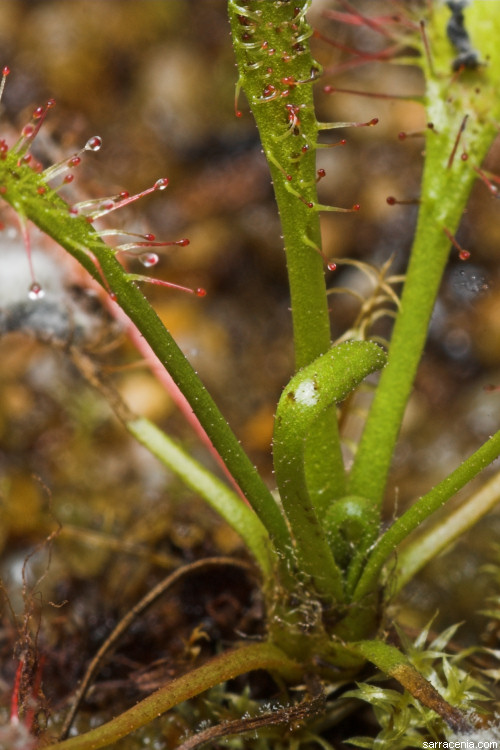
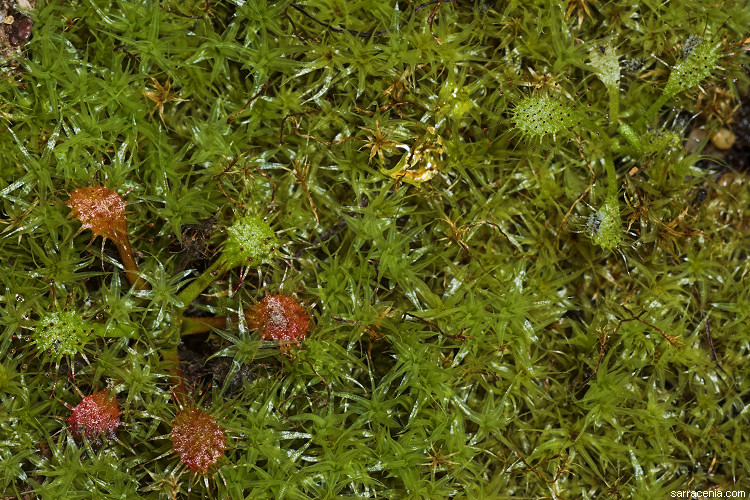
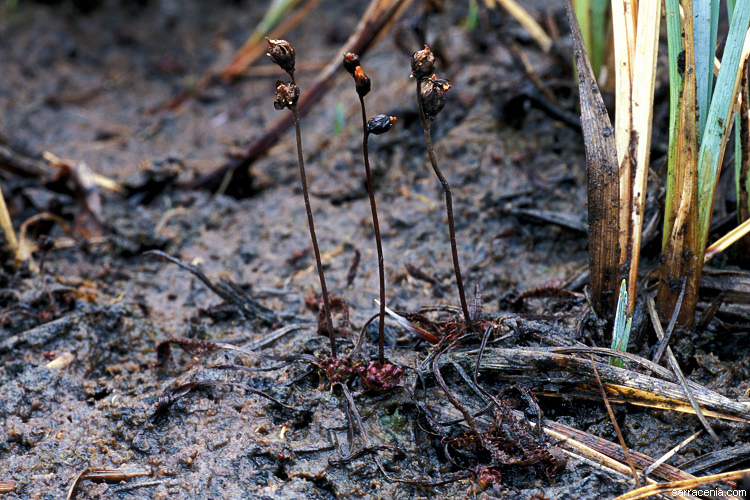
 D. linearis plantlet,
in cultivation D. linearis seedling,
in cultivation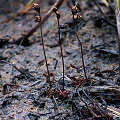 D. linearis,
sleeping in Montana
Really, if D. intermedia demonstrated such a variety of forms in South America, it would certainly have been described as at least
two distinct species!
Meanwhile, reports of D. intermedia in Idaho or Montana are incorrect. I have visited every such site where D. intermedia
was reported in Idaho and Montana--it is simply D. anglica. Sorry--not even a particularly
interesting form of the plant.
Drosera linearis
This plant is an interesting critter I have only seen it in the wild, in Montana. It is notorious among horticulturists as being
quite difficult to grow. (It tends to die during dormancy.) I grew it for a few years, finally getting it to flower and it was very
slow. Quite strangely, the seeds that I germinated came from another carnivorous plant grower with whom I exchanged a few seeds--a guy named
Terry Ratzmann. The reason that is strange....well, google him.
In the Great Lakes area, Drosera linearis often grows in marl sites.
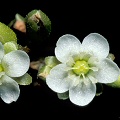 D. rotundifolia,
flowers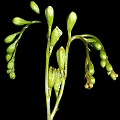 D. rotundifolia,
split scape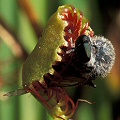 D. rotundifolia,
inland California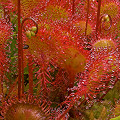 D. rotundifolia,
coastal California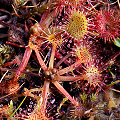 D. rotundifolia,
Montana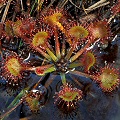 D. rotundifolia,
partially submerged
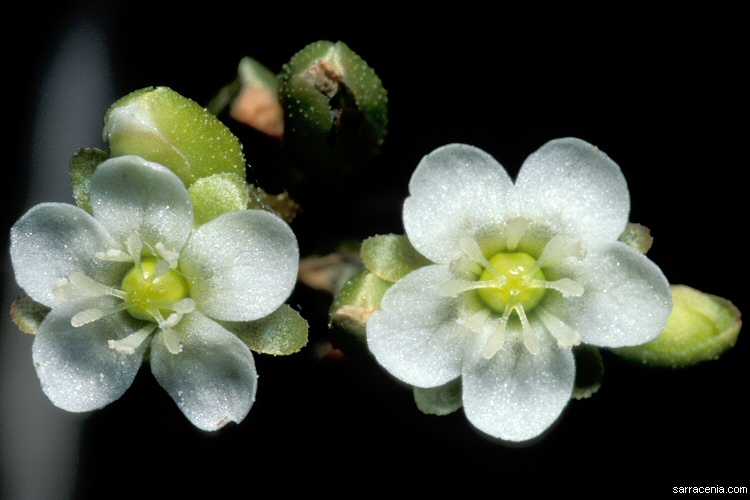
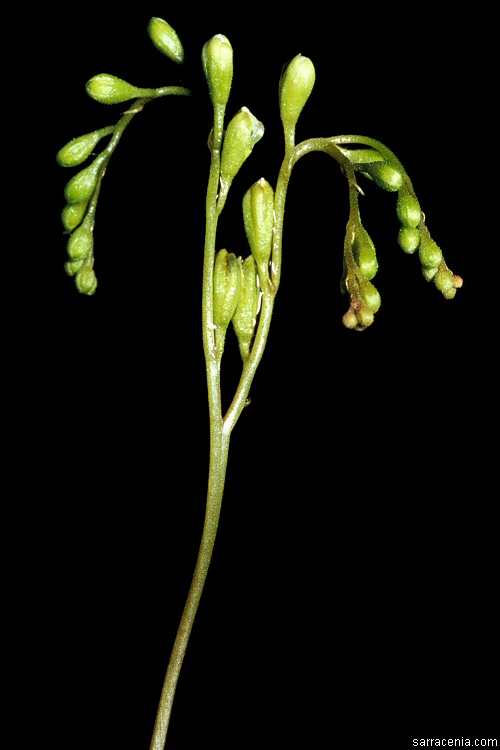
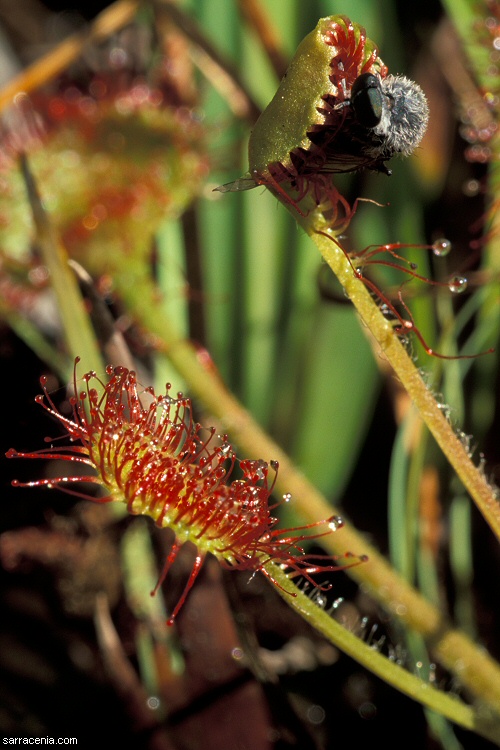
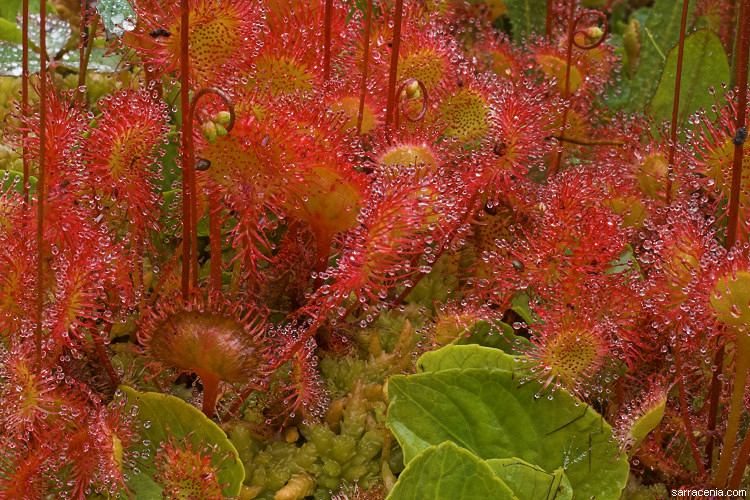
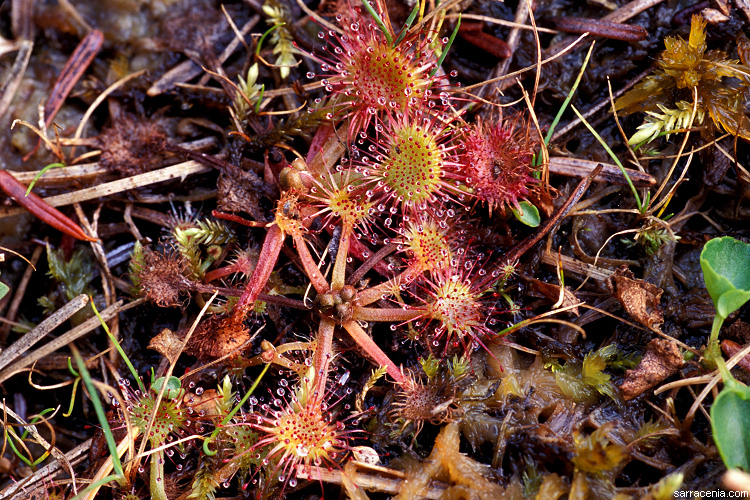
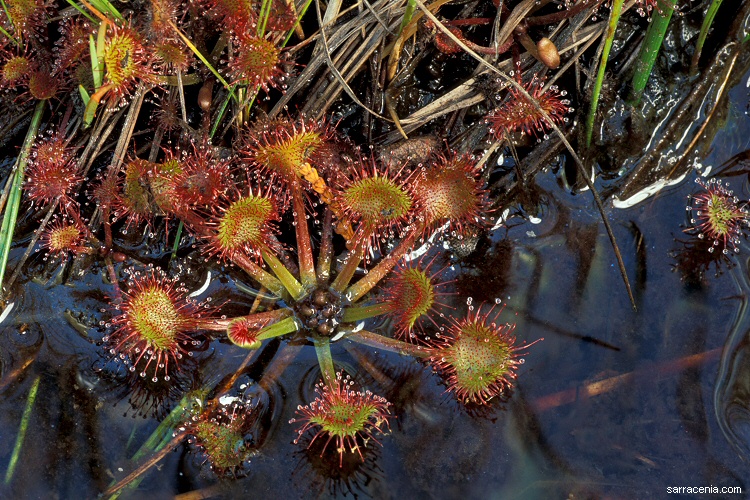
Drosera rotundifolia
This is a hugely widespread species, and is the one that Darwin performed all his experiments upon
(some of which were almost unspeakably odd, I note). Its leaf blades are round, or even wider than long. It has the darling
habit of closing its leaves over food bits.
Drosera tracyi
This name is used to describe the southern threadleaf sundew. It is similar to
D. filiformis, but is larger, and with much
paler leaves. Indeed, Drosera tracyi was formerly only a variety of
D. filiformis, i.e. D. filiformis var. tracyi.
For a complete argument as to why Drosera tracyi should be treated as a separate species from
Drosera filiformis, refer to Rice 2011a.
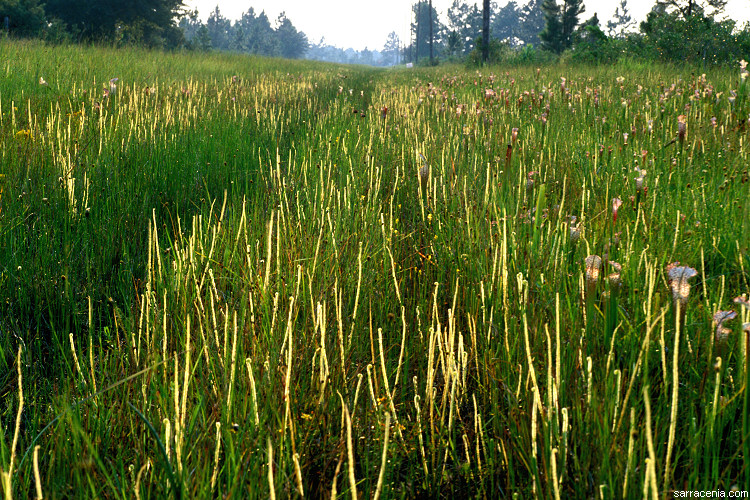
Seeing a field of these plants glistening in the humid mist of an Alabama sunrise, backlit and glowing, is a
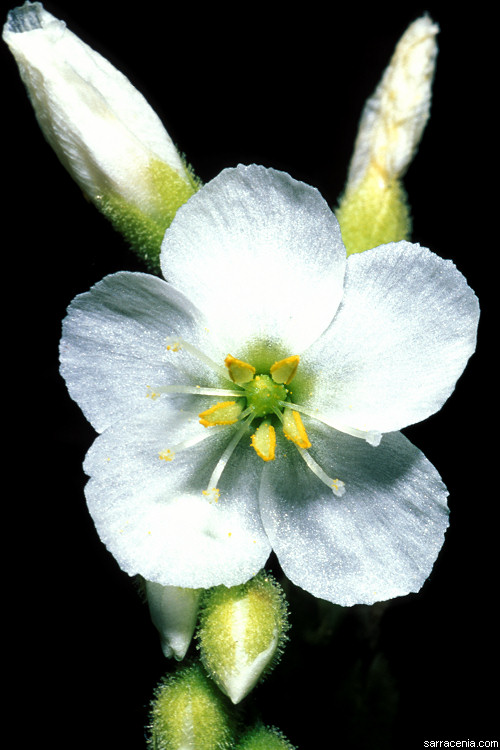
delight you must treat yourself to while such things can still be viewed. A completely anthocyanin-free form has been
discovered. While it looks very much like a regular plant when vegetative,
when it flowers you see immediately the white flowers that distinguishes it.
It is a common misconception that the name Drosera tracyi has not been validly published
according to the rules of botanical nomenclature. However, this is not the case. It came about because, originally,
in 1906 Diels wrote the Latin description of the name Drosera filiformis var.
tracyi. In this publication, Diels noted that J.M. MacFarlane considered the plant to be a
full species, but while he used MacFarlane's eptithet ("tracyi"), he did so at the
rank of variety. In 1914, Macfarlane elevated the name to species level (i.e., Drosera tracyi),
but did not include a Latin description, nor did he refer to Diels' description.
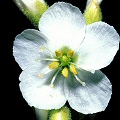 D. tracyi,
albino variant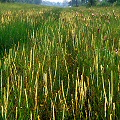 D. tracyi,
Florida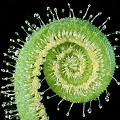 D. tracyi,
unfurling
From a modern perspective, this would make it seem that Drosera tracyi is therefore invalid
at the rank of species. But ICBN Art 36.1 says that the requirement of a Latin name is only needed for descriptions as
old as 1914: "On or after 1 January 1935 a name of a new taxon (algal and all fossil taxa excepted) must, in order
to be validly published, be accompanied by a Latin description or diagnosis or by a reference to a previously and
effectively published Latin description or diagnosis." However, this does not affect MacFarlane's venerable 1914
description, which did have an English description with it. Hence, Drosera tracyi Macf.
Hybrids
A number of hybrids between North American species have been created in horticulture or occur in the wild. Most
are sterile. And of course, D. anglica is thought
to be of hybrid origin.
D. ×californica =
D. filiformis var. filiformis × tracyi
This plant is about as large as D. tracyi but is slightly more richly colored reddish.
It was created by Joe Mazrimas, and goes by both this Latin name, or by the horticultural name
Drosera 'California Sunset.' The fact that Mazrimas lives in California explains why this
hybrid, which involves eastern USA species, has such an unfitting Latin name! This hybrid is peculiar among the North
American sundew hybrids in being fertile, which indicates how closely related the two species in its parentage
are.
D. ×eloisiana =
D. rotundifolia × intermedia
This hybrid is wrapped up in a debate as to whether is should be called by the name above, or the older
name D. ×belezeana. While priority rules would normally dictate the older name should be used,
well, the original type specimen for D. ×belezeana turned out to be just plain old
D. rotundifolia. So that name is out, and the new name is in.
D. ×californica var. arenaria =
D. filiformis var. floridana × tracyi
This is a naturally occurring sundew that can be found in a few places where the two parent species grow together in Florida. According to the
rules of botanical nomenclature, this plant must retain the absurd descriptor "californica", even though this plant
is not anywhere near California!
D. ×hybrida =
D. filiformis × intermedia
This plant has only ever been observed in New Jersey as a native, although I have seen planted specimens growing in California.
It it intermediate between the two species; long leaves with blunt tips. Easy to cultivate, it has been called a
"poor man's Drosera linearis", because of its vague similarity to that species.
 D. × hybrida
 D. × hybrida
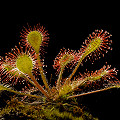 D. × obovata
(Ivan's Paddle)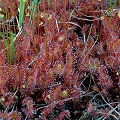 D. × obovata,
California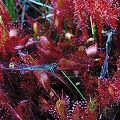 D. × obovata,
California
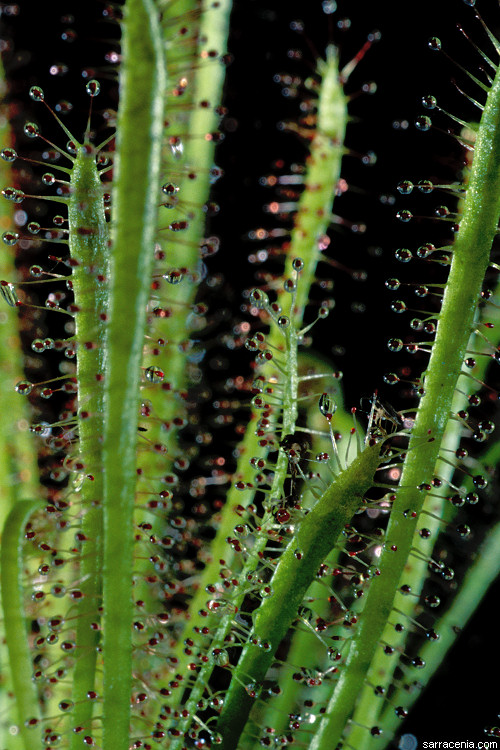
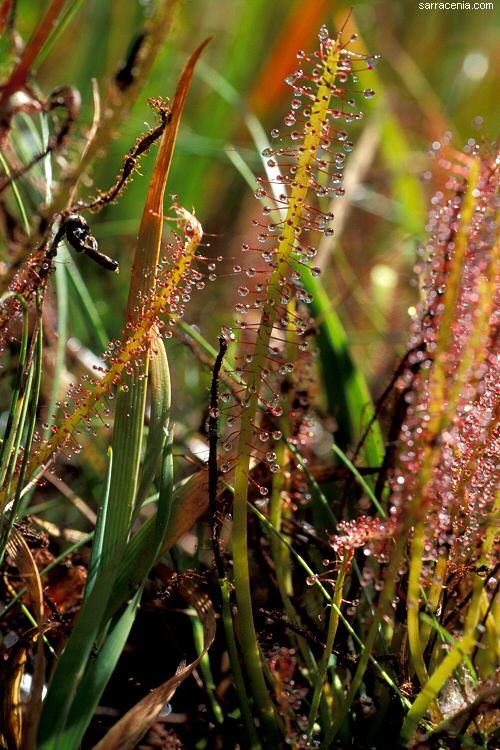
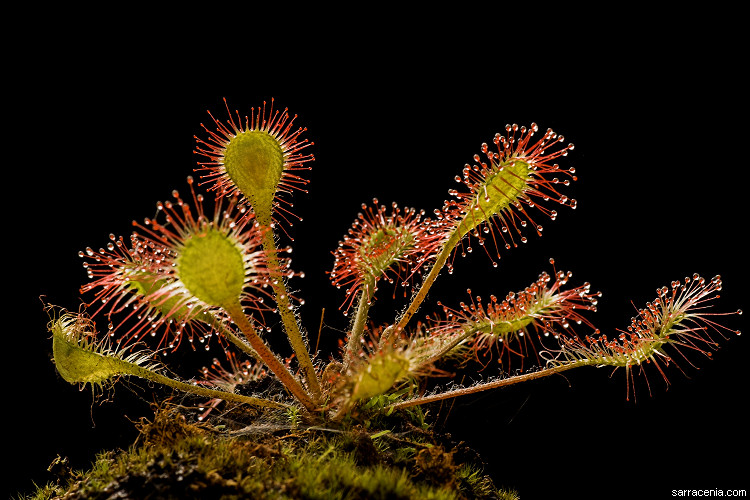
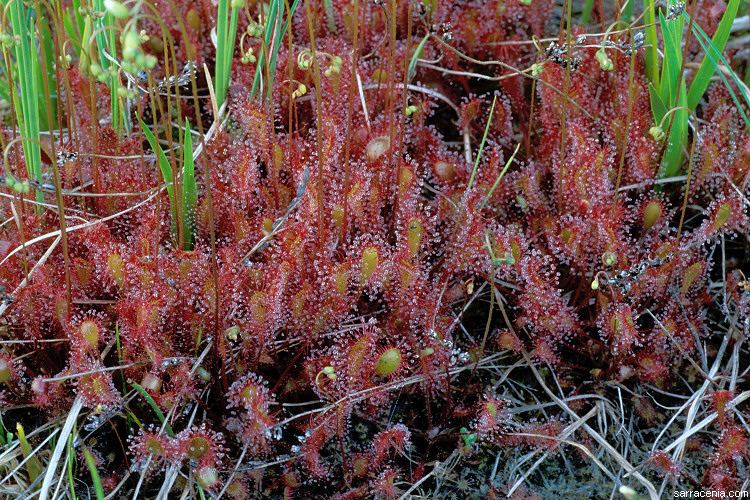
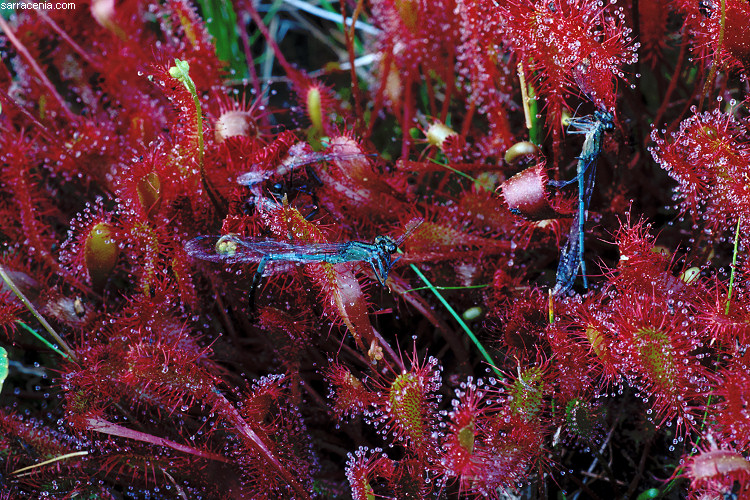
D. ×obovata =
D. rotundifolia × anglica
This plant has frequently been recorded wherever the parent plants both occur: Oregon, California, the Great Lakes province, New England, and
southeastern Canada. This plant is intermediate in characters between the parents. Sometimes they can be very difficult to separate
from Drosera anglica, especially when not in fruit. Typical leaf dimensions vary from site to site, mostly
because of the Drosera anglica parent involved in the
cross--D. ×obovata that descended from long-leaved
Drosera anglica may have leaves longer than short-leaved
Drosera anglica! A horticulturally developed version has the peculiarly eroto-punitive name of
"Ivan's Paddle."
Interestingly, if you accept that Drosera anglica is a plant of hybrid origin, but do not consider it to be a
good species in modern times, then
D. ×obovata would merely be considered (by botanical nomenclature) to be
a back-cross, and in such a case:
D. ×obovata = Drosera anglica =
D. ×anglica.
 D. × woodii
 D. × woodii
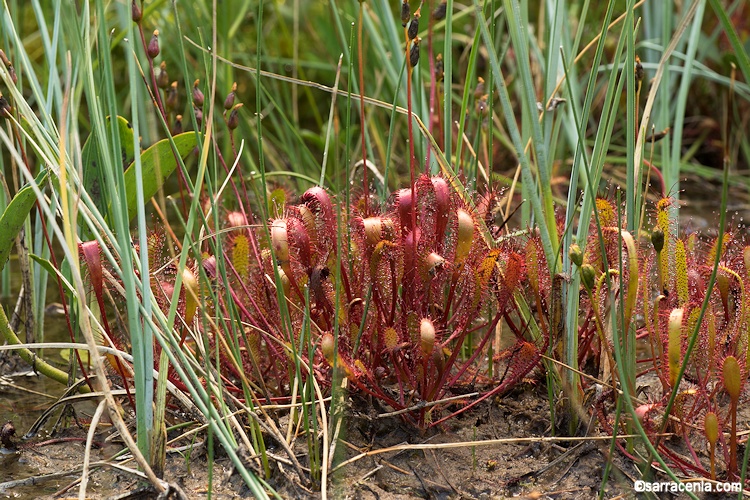
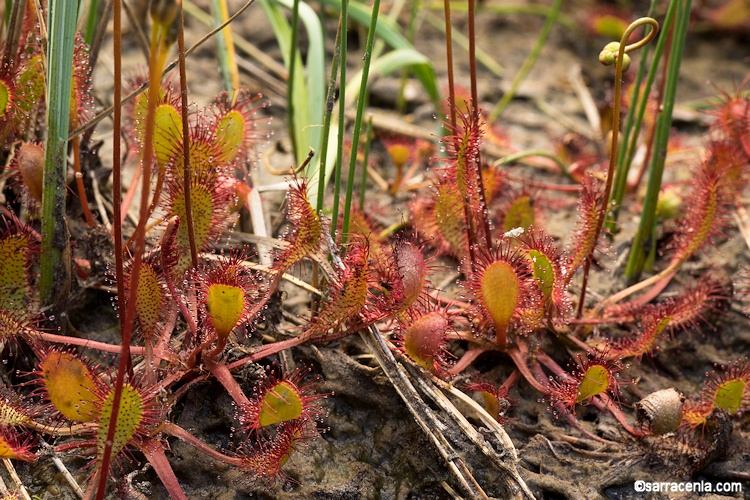
This is a hybrid with an interesting history. The current leading hypothesis is that long ago, the two parent species crossed (somewhere), and resulted in this sterile hybrid. Then, subsequently, by natural chromosome doubling, this hybrid transformed itself from a 2N=20 organism to a 2N=40 organism (read more about polyploidy if you don't understand that, but want to...). The new 2N=40 organism expanded in population, became a true, new species, and is what we know currently as D. anglica.
Anyway, it is possible today to see this hybrid--although it is unclear whether they are descendents of an ancient crossing event, or something more recent. It has been reported in Michigan, and I have found two populations of it (in a single site) in Montana.
D. anglica × linearis
Reported by Schnell in Michigan, I presume it could be very difficult to identify, although if it is a vigorous plant it might be identifiable because of its lush growth habits.
D. capillaris × intermedia
Reported by Sheridan in 1987 in North Carolina, I don't know if anyone has ever followed up on this plant to verify its hybrid nature. This plant could be related to the "long-leafed" D. capillaris.
Page citations: Lee, D., and Norden, A.W. 1972; Lowrie, A. et al. 2017a, 2017b; Rice, B.A. 2006a, 2011a, 2019b; Robinson, A. et al. 2017; Schlauer, J. 1996, 2002; Schnell, D. 1976, 1999b, 2002a; Sheridan, P.M. 1987.


