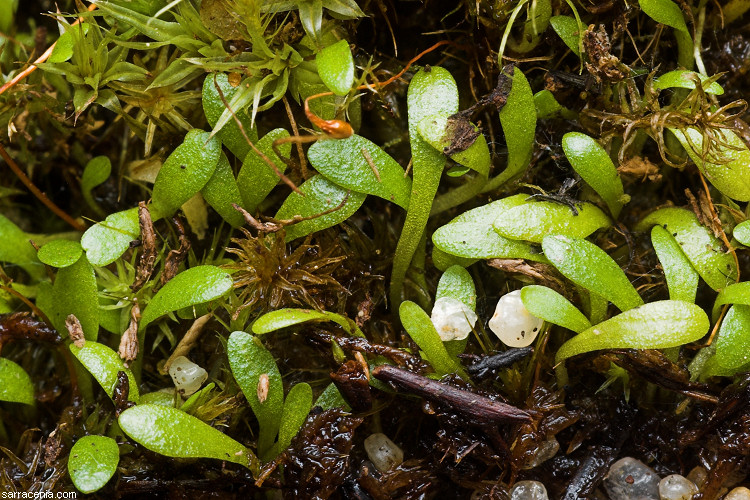
| Utricularia section Oligocista | ||
|---|---|---|
| Species | Range | Habit1 |
| U. adpressa | Latin America | T |
| U. albocaerulea | India | T |
| U. andongensis | Africa | T/L |
| U. arcuata | India | T |
| U. babui | India, Thailand | T |
| U. bifida | Asia, Australia | T |
| U. bosminifera | Thailand | T/AA |
| U. cecilii | India | T |
| U. chiribiquitensis | Columbia, Venezuela | T |
| U. circumvoluta | n Australia | T |
| U. delphinioides | Indo-China | T |
| U. erectiflora | Latin America | T |
| U. foveolata | Africa, Asia-Pacific | T/AA |
| U. graminifolia | China, Indo-China | T/AA |
| U. heterosepala | Philippines | AA |
| U. involvens | se Asia | T |
| U. jackii | Thailand | T |
| U. laxa | South America | T |
| U. lazulina | India | T |
| U. letestui | Central African Rep. | T |
| U. lloydii | South America | T |
| U. macrocheilos | Guinea, Sierra Leone | T |
| U. malabarica | India | T |
| U. meyeri | Brazil | T |
| U. micropetala | Africa | T |
| U. odorata | Indo-China, Australia | T |
| U. pierrei | Indo-China | T |
| U. pobeguinii | Guinea | T |
| U. polygaloides | India, Sri Lanka | T |
| U. praeterita | India | T |
| U. prehensilis | Africa | T |
| U. recta | Asia | T |
| U. reticulata | India, Sri Lanka | T/AA |
| U. scandens | Africa, Asia | T |
| U. smithiana | India | T/AA |
| U. spiralis | Africa | T |
| U. subramanyamii | India | T |
| U. tortilis | Africa | T |
| U. uliginosa | Asia, Australia | T/AA |
| U. vitellina | Malaysia | T |
| U. wightiana | India | T |
| 1T=terrestrial; L=lithophyte; AA=affixed aquatic. | ||
Q: About Utricularia section Oligocista
A: Section Oligocista is the largest in the genus. Since the lobes of
the calyx nearly enclose the fruit in some species, these plants were placed in a subgenus (Bivalvaria)
by Kurz. Although discarded in Taylor's treatment of the genus, subgenus Bivalvaria has been
resurrected in the new formulation of the genus that I follow, and once again includes section
Oligocista, but this time with other sections as well.
If you encounter a species in the
genus with a spur that extends away from the rest of the flower, it is very likely a member of this section. (But not all the
species have this character, so do not use it as an exclusive criterion.)
Many of these species are in cultivation and are easily grown as tropical terrestrials. Many of the really beautiful species
are not in cultivation, however, and would be marvelous additions to conservatories or private collections.
Utricularia albocaerulea--I have not seen this plant, but it would be nice to get this into
cultivation; it has flowers that are reportedly blue---not purple or pink, but really blue!
Utricularia andongensis--While the yellow flowers of this plant are not really too much to write
home about, the leaves are actually fairly large (up to several cm long) and would be very interesting to study.
Utricularia bifida--I have grown this plant, but it was really unremarkable.
It has small flowers that are not much larger than the calyx lobes, and in general not very pretty. Snoooooze.
Utricularia delphinioides--This plant, which makes dense inflorescences with many scented, dark-purple
flowers, would be a real gem in cultivation. Oooooh, desire; oh avarice!
Utricularia graminifolia--A species with
a number of different forms in cultivation. Many are listed as
being U. reticulata, but none that I have seen with this identification were correctly
labelled. I list this plant also as an affixed aquatic because it really thrives when grown in extremely wet conditions. It loves
to grow out of the bottom of a pot and colonize the open water of a tray.
Utricularia lazulina--Another plant that, from the descriptions, sounds extremely pretty. Like
Utricularia albocaerulea, it supposedly has clear blue flowers. Oooh.
Utricularia prehensilis--This species has twining scapes, which are a lot of fun to train up little
sticks. The leaves are long, strap shaped, and hug the soil. For more on this species, refer to
this ancient paper I wrote for Carnivorous Plant Newsletter.
Utricularia reticulata--As I mention under my comments on
Utricularia graminifolia, I have found many so-called
"Utricularia reticulata" plants that were incorrectly identified.
Utricularia uliginosa--Another extremely easily grown species, in fact one that is too easily
grown. It produces seed from its short-lived flowers, and these seed are all too determined to infest every one of your pots.
Be very careful about letting this plant escape from its pot!
Utricularia vitellina--A small terrestrial species with characters that are a little strange for
the section---Taylor thought this might merit relocation to section Chelidon but ultimately decided
not to do so.
Page citations: Rice, B.A. 1994f, 2006a; Taylor, P. 1989; personal observations.