| Utricularia section Aranella | ||
|---|---|---|
| Species | Range | Habit1 |
| U. blanchetii | Brazil | T |
| U. costata | Brazil, Venezuela | T |
| U. fimbriata | Brazil, Colombia | T |
| U. laciniata | Brazil | T |
| U. longeciliata | South America | T |
| U. parthenopipes | Brazil | T |
| U. purpureocaerulea | Brazil | T |
| U. rostrata | Brazil | T |
| U. sandwithii | South America | T |
| U. simulans | Africa, Latin America, USA | T |
| 1T=terrestrial. | ||
Q: About Utricularia subgenus Bivalvaria section Aranella
A: This Utricularia consists of a set of terrestrial species, all
mostly in South America. They have been grouped into this section because they have similar traps, the upper corolla lips have an
interesting little curve near the central base that forms a kind of pocket, and also the bracts and sometimes calyx lobes are
usually ragged-edged to deeply fimbriate-lobed.
Molecular work suggests that this section might not be monophylletic--watch for it possibly being broken up in the future.
Utricularia blanchetii
This terrestrial species is particularly gratifying to grow because the flowers
are exceptionally pretty, as they show a delicate range of blue to purple coloration. When they are not in flower, the extremely
delicate foliage can be very easily lost---do not toss this plant unless you are sure it has died!
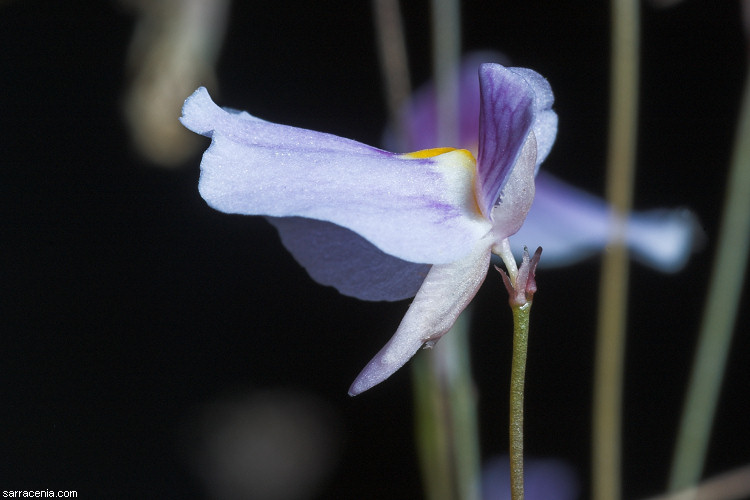
U. blanchetii
Utricularia simulans
This plant has a really remarkable range. Its Latin American range includes Cuba,
Belize, Colombia, Venezuela, Guyana, Surinam, French Guiana, Brazil, Bolivia, and Paraguay, and it occurs in several counties in
peninsular Florida. But what is really remarkable is that it ranges into Africa, too! Furthermore, Taylor notes that it has been
reported to form tubers! I have looked for this plant a few times in Florida, but each time I arrived at a "sure site"I
found instead only newly established golf courses.
Page citations: Fleischmann, A. & Rivadavia, F. 2009; Müller, K.F. et al. 2006;
Rice, B.A. 2006a; Taylor, P. 1989; personal observations.


