Q: Byblis: species
| Byblis species |
|---|
|
Byblis aquatica Lowrie & Conran Byblis filifolia Planch. Byblis gigantea Lindl. Byblis guehoi Conran & Lowrie Byblis lamellata Conran & Lowrie Byblis liniflora Salisb. Byblis pilbarana Lowrie & Conran Byblis rorida Lowrie & Conran |
A: The genus is small.
Oddly enough, some of my own observations of the plants in cultivation were cited as
important evidence that some of the plants that had been discovered and were in cultivation in the 1990s merited separate
species status! Even horticulture by casual enthusiasts can yield cool science! This is a reminder to us all, to carefully
document even our little cultivation experiments.
The two species B. gigantea and B. lamellata are very
similar, and are coarse perennial species up to about 70 cm tall that can resprout from rootstocks. The rest of the species
(sometimes refered to as the Byblis liniflora complex) are smaller, more delicate,
and in cultivation are at most annuals or short-lived biennials.
The species in this genus are sometimes very difficult to tell apart, especially when the plants are young or are
grown in less than ideal conditions. The keys that field researchers use to separate to species depend upon several features,
most of which require close inspection of the flowers or seeds. For example, the length of the anthers, compared to the length of the
filaments, is a critical feature. So do not expect me to be able to sight-ID these plants
from sloppy photographs e-mailed to me. Most of the Byblis plants in casual cultivation are
Byblis liniflora,
but Byblis filifolia is also common in collections.
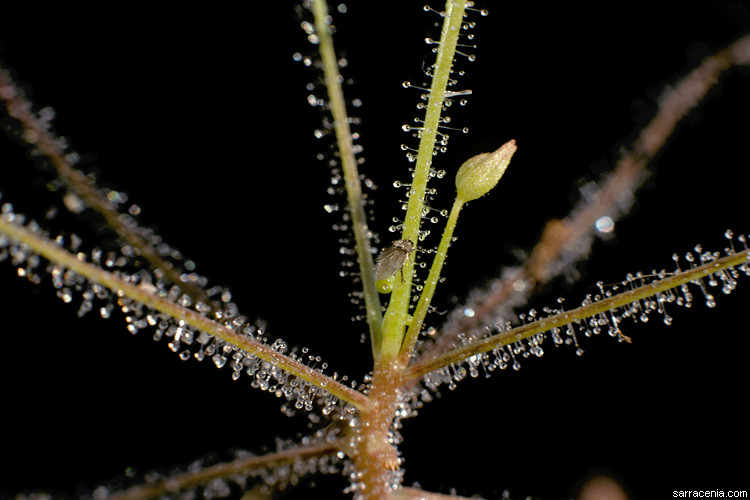
 B. liniflora
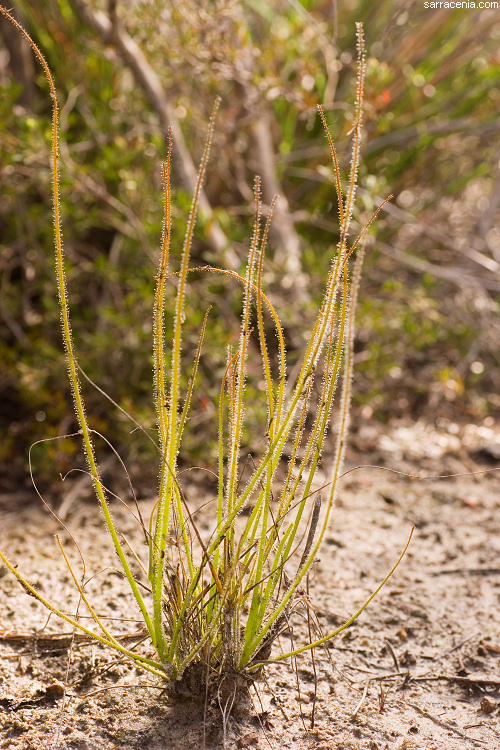
 B. gigantea
A fossil seed, similar to the modern members of the Byblis liniflora complex, was found in South Australia near
Adelaide. Unfortunately, it has not been given a name for a very sad reason, the nature of which are revealed in the
original research paper but which I don't care to tell you, so as to encourage you to venture into a library.
Page citations: Conran, J.G., & Christophel, D.C. 2004;
Conran, J.G. et al. 2002;
Hartmeyer, S. 1997, 1998; Lowrie, A. 2013;
Lowrie, A. & Conran, J.G. 1998, 2008; Rice, B.A. 1993, 2006a; Schlauer, J. 2002; personal observations.


